Fact sheet
Taft Granite
This rock is a medium-grained biotite granite typical of “salt and pepper” granites of the Sierra Nevada. Calkins (1930) named the granite for Taft Point in Yosemite, recognizing it as one of the key members of the Intrusive Suite of Yosemite Valley. U.S. Geological Survey (USGS) scientist Franklin Dodge collected FD-12 near “The Fissures” at Taft Point as part of his Sierra Nevada Reference Collection. Dodge’s (1963) own dissertation research was focused on accessory minerals in Yosemite National Park, but this sample was not a part of his PhD, and was collected afterwards, likely in 1965. FD-12 was used regularly in batholith-wide igneous rock and mineral studies by the USGS from 1968 to 1982. It was the only “FD” series sample to be dated in the seminal U-Pb zircon study of Stern et al. (1981). As noted by Putnam and others (2015), radiometric dating of the Taft Granite was challenging. Stern et al. (1981) reported a discordant bulk U-Pb zircon age of ca. 95 million years (Ma) for FD-12. Ratajeski et al. (2001) report zircon U-Pb ages near concordia of 105–102 Ma; Putnam et al. (2015) themselves dated a sample of Taft Granite to 106.6 ± 0.7 Ma. More recently, U-Pb dating of zircon from the original FD-12 sample, conducted at Pomona College, yielded a weighted mean age of 106.7±1.3 Ma (Lackey, unpublished).
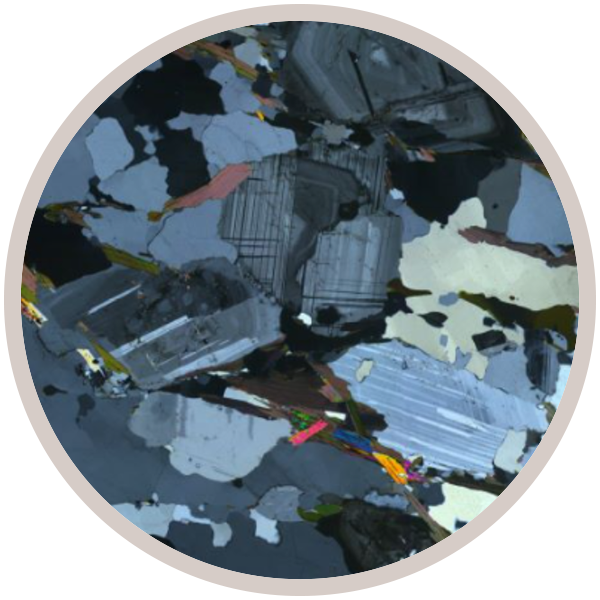
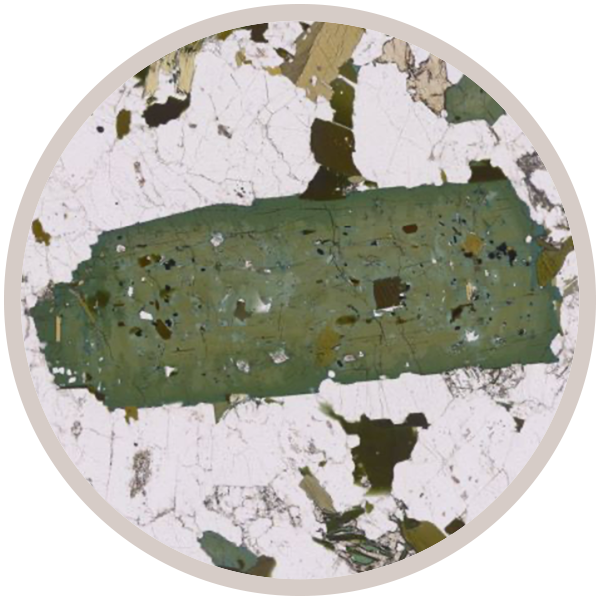
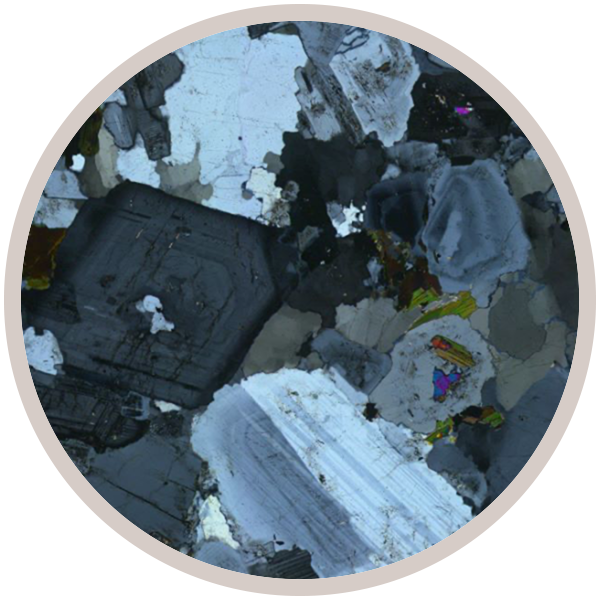
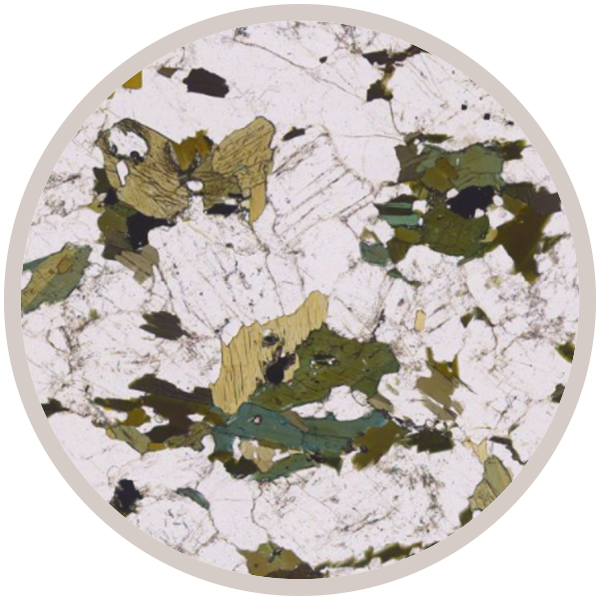
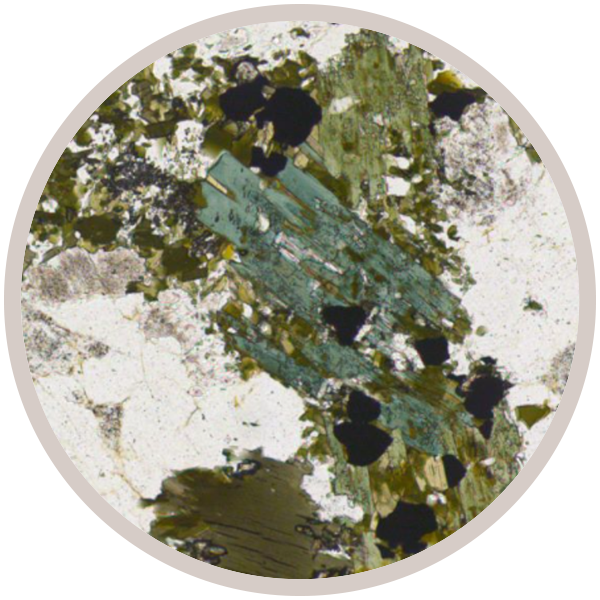
In View 1, some smaller plagioclase crystals are zoned, but also have a distinct, thin rim overgrowth which is clear under PPL. Not all plagioclase grains in the thin section show this, but it is widespread. Lamellar twins in the irregular grain to the left of the crosshairs are continuous from the core to the rim. Quartz, K-feldspar and biotite are also present.
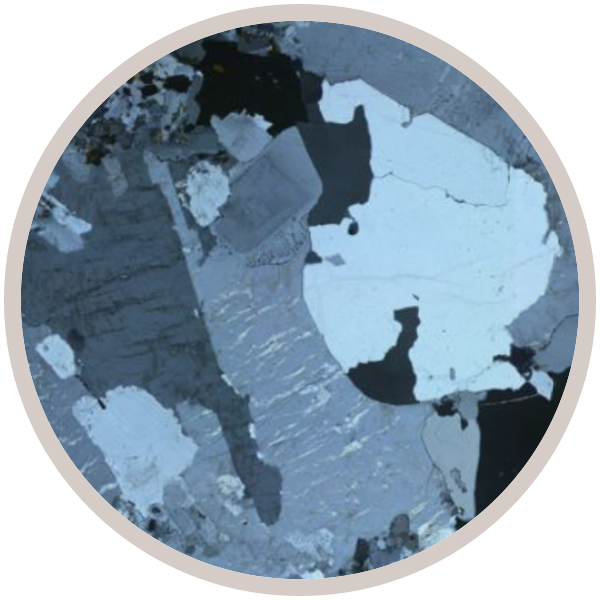
View 2 is dominated by a large, tabular K-feldspar crystal with simple twinning and cross-hatch twinning in some parts of the grain. Perthitic texture is conspicuous in one half of the crystal. Lobes of myrmekite are visible in the lower left and upper left quadrants, the latter on the edge of the field of view.
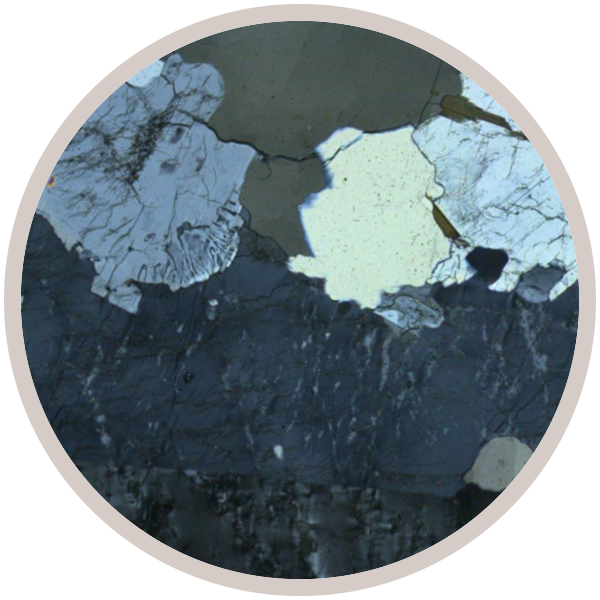
View 3 features a chunky plagioclase crystal with a clear simple twin and internal zoning. A line of inclusions marks the outline of a core, suggesting a hiatus in growth. Two small biotite grains are partially altered to chlorite.
References
Calkins, F.C., 1930, The granitic rocks of the Yosemite region. U.S. Geological Survey Professional Paper, v. 160, p. 120–129.
Dodge, F. C. W., 1963, A mineralogical study of the intrusive rocks of the Yosemite Valley area, California. [PhD Dissertation]: Stanford University, 128 pp, 2 plates.
Putnam, R., Glazner, A. F., Coleman, D. S., Kylander-Clark, A. R. C., Pavelsky, T., and Abbot, M. I., 2015, Plutonism in three dimensions: Field and geochemical relations on the southeast face of El Capitan, Yosemite National Park, California. Geosphere, v. 11, no. 4, p. 1–25.
Ratajeski, K., Glazner, A. F., and Miller, B. V., 2001, Geology and geochemistry of mafic to felsic plutonic rocks in the Cretaceous intrusive suite of Yosemite Valley, California. Geological Society of America Bulletin, v. 113, no. 11, p. 1486-1502.
Stern, T. W., Bateman, P. C., Morgan, B. A., Newell, M. F., and Peck, D. L., 1981, Isotopic U-Pb ages of zircon from the granitoids of the central Sierra Nevada, California. U. S. Geological Survey Professional Paper v. 1185, p. 17.