Fact sheet
Garnet trondhjemite of Sherman Thomas Ranch
Foliated, garnet-muscovite, biotite trondhjemite. The sample is from 1587 feet (483.7 m) deep in the westernmost borehole of six drilled in the mid-1960s by the U.S. Geological Survey for heat flow studies that Art Lachenbruch (1968) directed across the Mariposa 1° x 2° quadrangle. The ST-1 borehole was drilled on the Sherman Thomas Ranch in the Sierran Foothills “1.75 km W-SW of the junction of Madera, Merced, and Mariposa counties” (Lachenbruch, 1968). ST-1’s apatite crystals yielded an age of 128 million years old in the first fission track study in the Sierra Nevada (Naeser and Dodge, 1969), one that would help launch Chuck Naeser’s decades-long thermochronology career with the USGS. Because of the sample’s unusual peraluminous composition, old age, and position at the westernmost edge of the Sierra Nevada, ST-1 was used in numerous other tran-Sierra studies. Kistler and Peterman (1973) used core section #11 (ca. 1111 ft/339 m) in their seminal Sr isotope study of the Sierra, designating ST-1 as “73–28”. Sample 73–28 was re-used in studies of Pb (Doe and Delevaux, 1973), Nd (DePaolo, 1981), and O (Masi et al., 1981) isotopes. It is one of the few samples analyzed for all the traditional petrologic isotope systems. Kistler and Fleck related 73–28 back to its ST-1 roots in a 1994 USGS field trip report (Kistler and Fleck, 1994). A preliminary zircon U-Pb age for ST-1 is ca. 136 ± 2 million years old (Lackey, unpublished data).
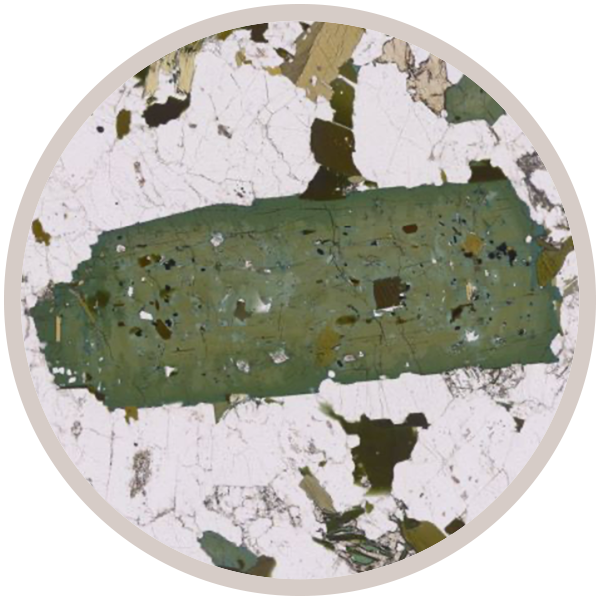
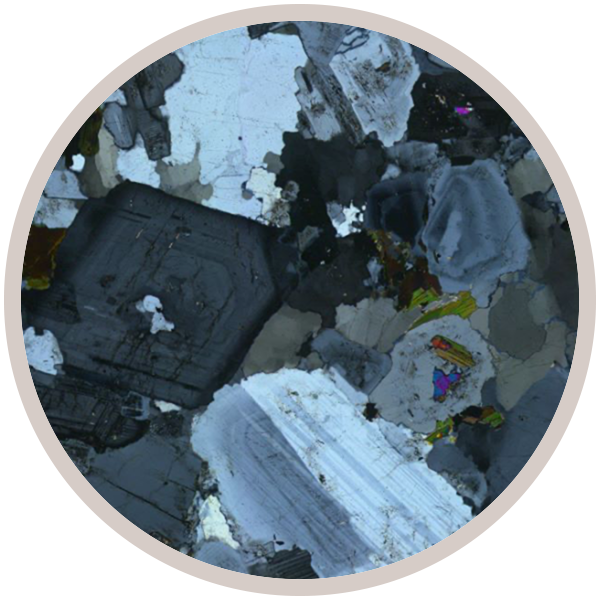
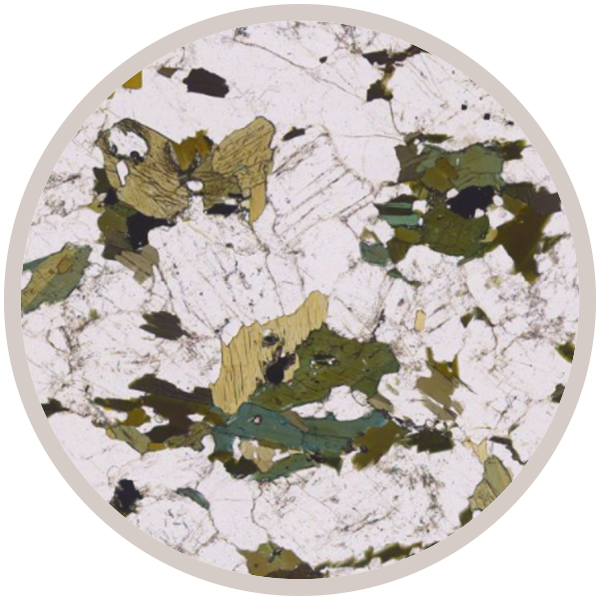
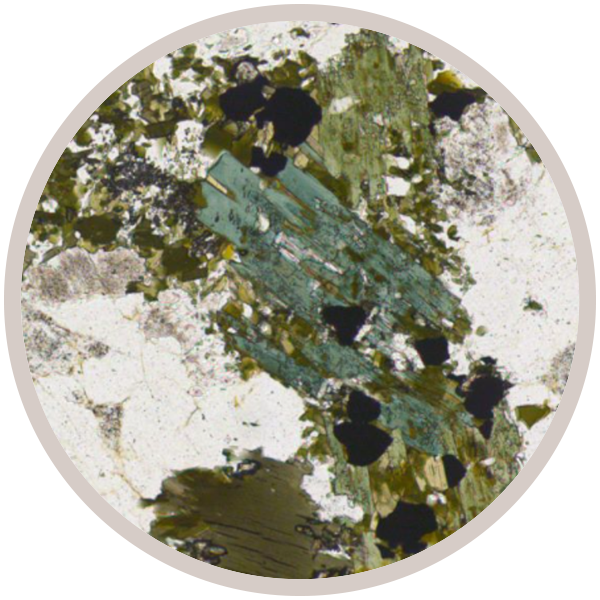
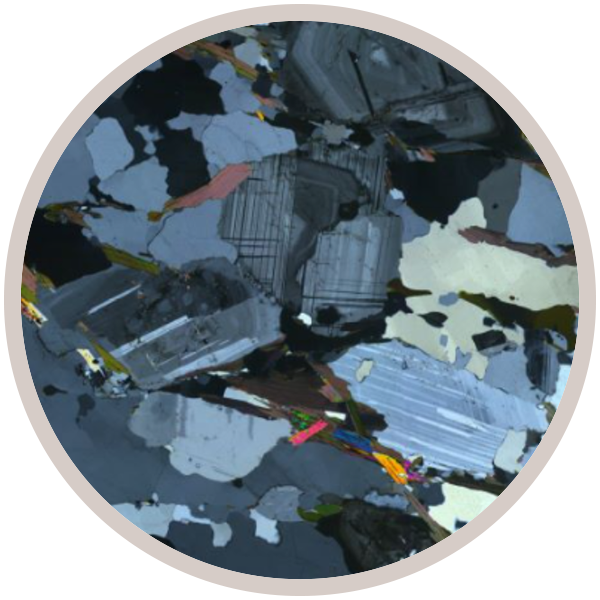
This rock is deformed, with a weak foliation defined by biotite and muscovite laths draping feldspar grains; the fabric runs horizontally across the section . Garnets are uncommon, euhedral to subhedral and inclusion-poor. Micas tend to form thin, elongate laths. Some chlorite laths and sheaves show beautiful, anomalous violet interference colours. Plagioclase displays lamellar and simple twinning, as well as oscillatory zoning. Many quartz grains are strained, exhibiting undulose or patchy extinction and incipient subgrain formation.
View 1 features a cluster of garnets, indicating the peraluminous nature of this granitoid. Quartz, plagioclase and small biotite grains also occur in the field of view.
View 2 demonstrates a deformation texture with a raft of muscovite laths, biotite and chlorite draped over a zoned plagioclase feldspar grain.
View 3 shows a large quartz grain with patchy, undulose zoning indicating weak deformation and incipient formation of subgrains. The colourless, equant crystal with moderate relief included in the large quartz grain is apatite.
References
DePaolo, D.J., 1981, D.J., 1981, A neodymium and strontium isotopic study of the Mesozoic calc-alkaline granitic batholiths of the Sierra Nevada and Peninsular Ranges, California: Journal of Geophysical Research. B, v. 86, p. 10470-10488.
Doe, B.R., and Delevaux, M.H., 1973, Variations in lead-isotopic compositions in Mesozoic granitic rocks of California: a preliminary investigation: Geological Society of America Bulletin, v. 84, p. 3513–3526.
Lachenbruch, A.H., 1968, Preliminary geothermal model of the Sierra Nevada: Journal of Geophysical Research, v. 73, p. 6977-6989.
Naeser, C.W., and Dodge, F.C.W., 1969, Fission-Track Ages of Accessory Minerals from Granitic Rocks of the Central Sierra Nevada Batholith, California: Geological Society of America Bulletin, v. 80, p. 2201–2212.
Masi, U., O'Neil, J.R., and Kistler, R.W., 1981, Stable isotope systematics in Mesozoic granites of central and northern California and southwestern Oregon: Contributions to Mineralogy and Petrology, v. 76, p. 116-126.
Kistler, R.W., and Peterman, Z.E., 1973, Variations in Sr, Rb, K, Na, and initial Sr87/Sr86 in Mesozoic granitic rocks and intruded wall rocks in central California: Geological Society of America Bulletin, v. 84, p. 3489-3512.
Kistler, R.W., and Fleck, R.J., 1994, Field guide for a transect of the central Sierra Nevada, California: geochronology and isotope geology: U. S. Geological Survey Open-File Report, v. 94-0267, 50 pp.