Fact sheet
Dinkey Creek Granodiorite
Foliated hornblende-biotite granodiorite. SL-1 was one of six boreholes drilled in the mid-1960s by the U.S. Geological Survey for heat flow studies that Art Lachenbruch (1968) directed across the Mariposa 1°x 2° quadrangle. SL-1 was the first borehole drilled in this effort, south of Shaver Lake, California. The core was drilled over two months using a Boyles Brothers diamond drill core rig with a BQ bit producing 36.5 mm diameter core (Moses, T., written comm.). SL-1 first appears in Lachenbruch’s preliminary (1968) heat flow study and another by Wollenberg and Smith (1968) who studied radiogenic heat production in the Sierran crust. SL-1 is named in other studies until the early 1980s (Dodge et al., 1982). The #25 core section featured in thin section is from a depth in the borehole of 1,490 feet (454 m). It shows strong foliation defined by aligned hornblende crystals, a common feature of the Dinkey Creek Granodiorite (Bateman, 1992). Stern et al. (1981) used SL-1 to obtain the first U-Pb zircon age for the Dinkey Creek Granodiorite, measuring a discordant 206Pb/238U age of 104.1 ± 1 million years old. In the area of the SL-1 borehole, newer U-Pb zircon dating shows the Dinkey Creek pluton is ca. 101 ± 1 million years old (Lackey et. al., 2012).
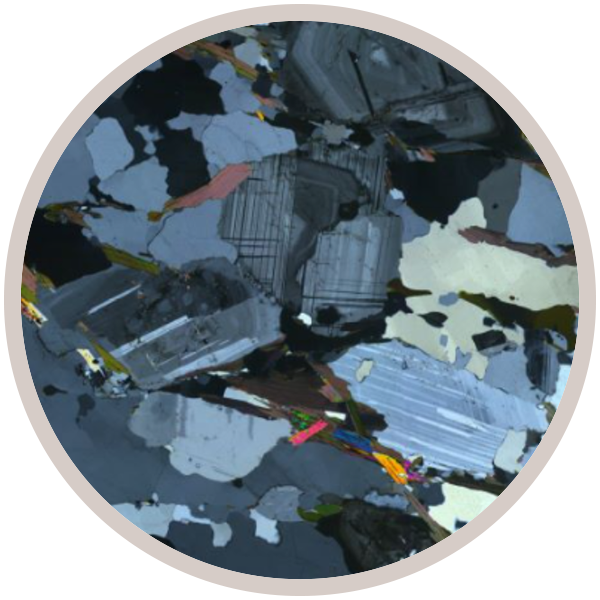
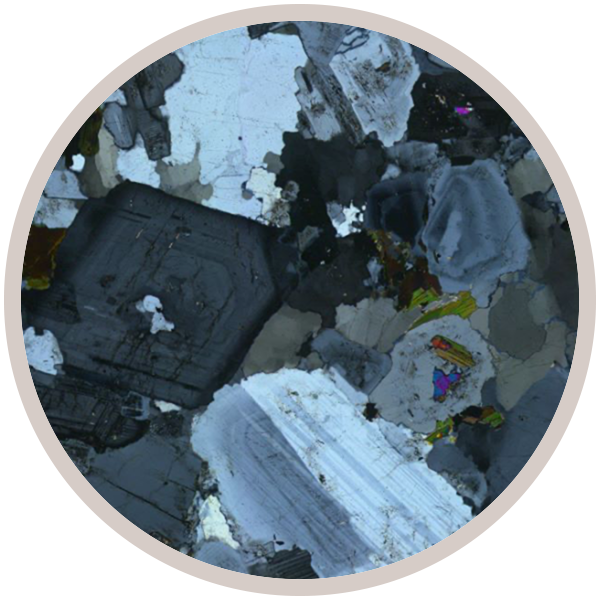
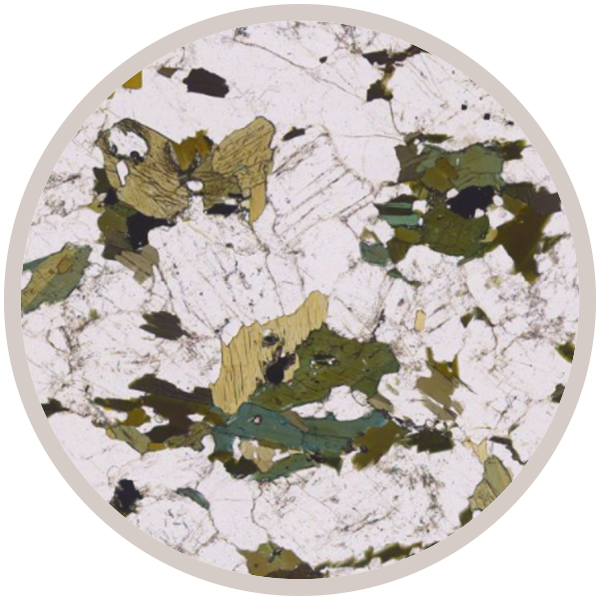
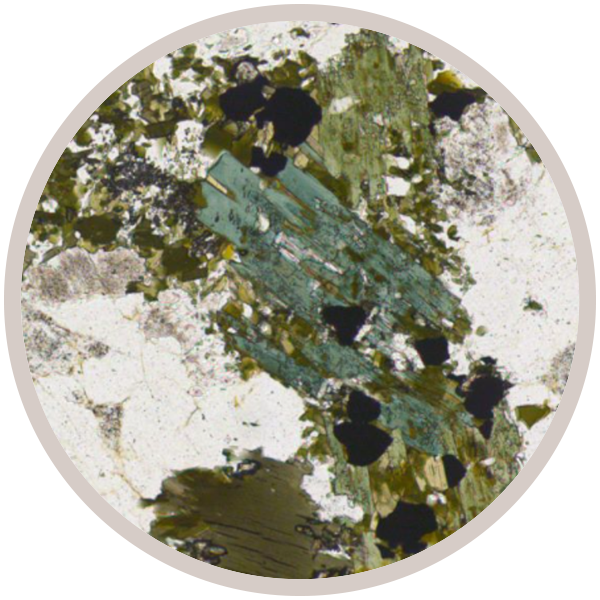
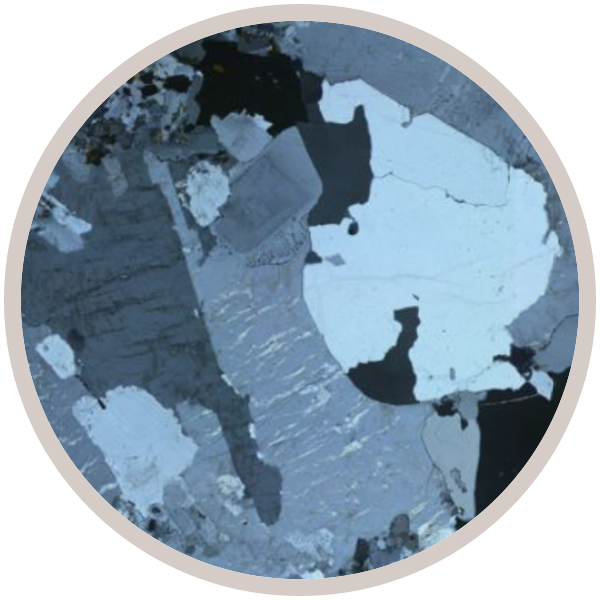
This granodiorite contains attractive, zoned hornblende phenocrysts, some showing clear twinning and intersecting amphibole cleavage. Biotite is also common, a few with high-relief accessories surrounded by thin pleochroic haloes. Subhedral to anhedral titanite is also widespread, along with opaque oxides. Epidote is typically associated with hornblende. Quartz and plagioclase dominate the colourless portions of the section. Many plagioclase crystals are euhedral or subhedral, with fine lamellar twinning and spectacular oscillatory zoning, commonly overgrown by a clear rim. Small crystals of apatite are scattered sparsely through the rock.
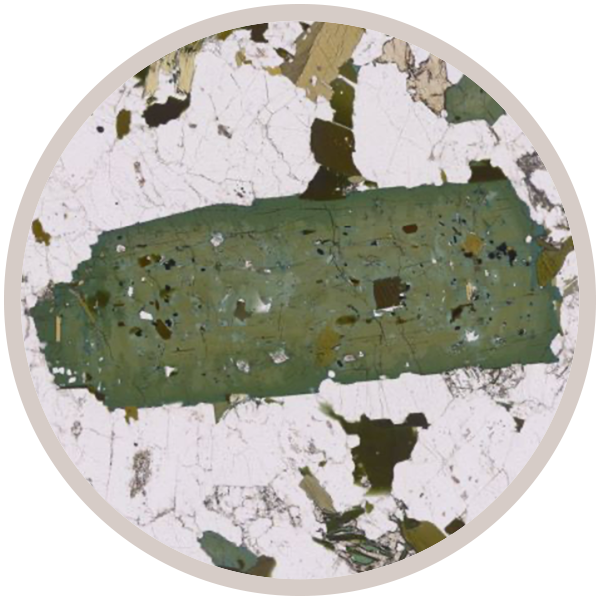
View 1 is dominated by a large hornblende with simple and lamellar twins. In PPL it is also zoned, from patchy olive green colours in the core to darker green at the rim. The core zone, comprising much of the grain, has abundant inclusions of biotite, quartz, feldspar and opaque oxides. Inclusions in the rim are sparser and coarser. Crystals of titanite, epidote and biotite occur at the margins of the hornblende grain.
View 2 shows a small cluster of epidote crystals intergrown with hornblende and biotite, suggesting the epidote is conformably magmatic rather than a result of later alteration. Well-formed epidote crystals elsewhere in the thin section provide further evidence of this, particularly some that are included in hornblende like those around (14.5, 0.3). The epidotes display anomalous, dark blue interference colours.
View 3 showcases several feldspar grains with lamellar twinning and oscillatory zoning, visible in XPL; some also have simple twins. Hornblende, biotite and quartz are also present.
References
Bateman, P. C., 1992, Plutonism in the central part of the Sierra Nevada Batholith, California: U. S. Geological Survey Professional Paper 1483, 182 pp.
Dodge, F. C. W., Millard, H. T., Jr., and Elsheimer, H. N., 1982, Compositional variations and abundances of selected elements in granitoid rocks and constituent minerals, central Sierra Nevada Batholith, California: U. S. Geological Survey Professional Paper, p. 24.
Lachenbruch, A.H., 1968, Preliminary geothermal model of the Sierra Nevada: Journal of Geophysical Research, v. 73, p. 6977-6989.
Lackey, J.S., Cecil, M., Windham, C.J., Frazer, R.E., Bindeman, I.N., and Gehrels, G.E., 2012, The Fine Gold Intrusive Suite: The roles of basement terranes and magma source development in the Early Cretaceous Sierra Nevada batholith: Geosphere, v. 8, p. 292-313.
Stern, T. W., Bateman, P. C., Morgan, B. A., Newell, M. F., and Peck, D. L., 1981, Isotopic U-Pb ages of zircon from the granitoids of the central Sierra Nevada, California: U. S. Geological Survey Professional Paper, 17 pp.
Wollenberg, H.A., and Smith, A.R., 1968, Radiogeologic studies in the central part of the Sierra Nevada Batholith, California: Journal of Geophysical Research, v. 73, p. 1481-1495.