Fact sheet
Granodiorite of Goddard Canyon
Deformed and altered hornblende-biotite granodiorite. KR is from a small Jurassic pluton embedded in the Mount Goddard roof pendant in northern Kings Canyon National Park. The pluton is strongly sheared and contains secondary alteration minerals like chlorite, epidote, and sericite. During field mapping of the pluton in August and September, 1960, field stations and sketches abbreviated the pluton as 'Cgrd'. Paul Bateman (1992) explains that the pluton “was so altered that during mapping it was referred to as 'the cruddy granodiorite'” before it was formally named the granodiorite of Goddard Canyon. Field notes also show that as Bateman and his assistants mapped, they paid great attention to a network of northwest-trending, basaltic to rhyolitic dikes that cross-cut the pluton. The following year Moore and Hopson (1961) formally named the Independence Dike Swarm (IDS) which is widespread across much of Eastern California. Because the granodiorite of Goddard Canyon was cut by IDS dikes of late Jurassic age (148 million years old, Chen and Moore, 1979), the pluton was assigned a middle Jurassic age by Bateman (1992). KR has a U-Pb zircon age of 165.8±0.87 million years old (Lackey, unpublished), confirming Bateman’s age assignment. The sample does not bear a 'BCb' prefix and thus was not collected during original mapping of the Blackcap Mountain quadrangle (Bateman, 1965). Franklin W.C. Dodge evidently collected the sample for his Mariposa Quadrangle reference suite between 1965 and 1966. The sampled was used for a burst of mineral-chemistry studies in the late 1960s: (Piwinskii et al. 1968; Dodge et al. 1968, 1969) and was featured regularly in studies until the 1980s. An initial 87Sr/86Sr of 0.70628 is calculated for the pluton from unpublished measurements of Kistler (written comm., 2001).
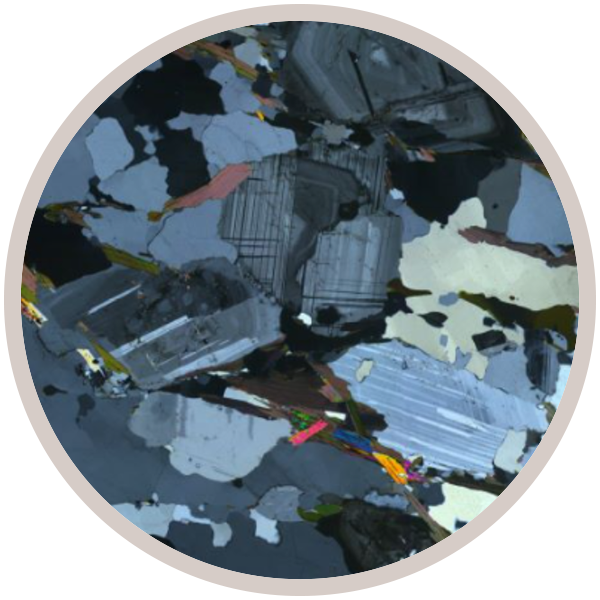
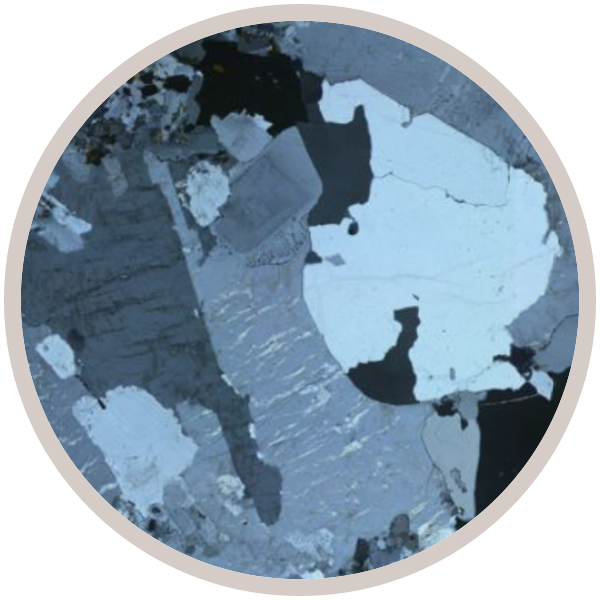
Most of View 1 is composed of heavily sericitised plagioclase feldspar, with sutured boundaries in places and some zoning. Some crystals show clear rims/overgrowths. Biotite has been chloritised. There are two moderate relief, colourless crystals of apatite in the lower left quadrant, which are unaltered.
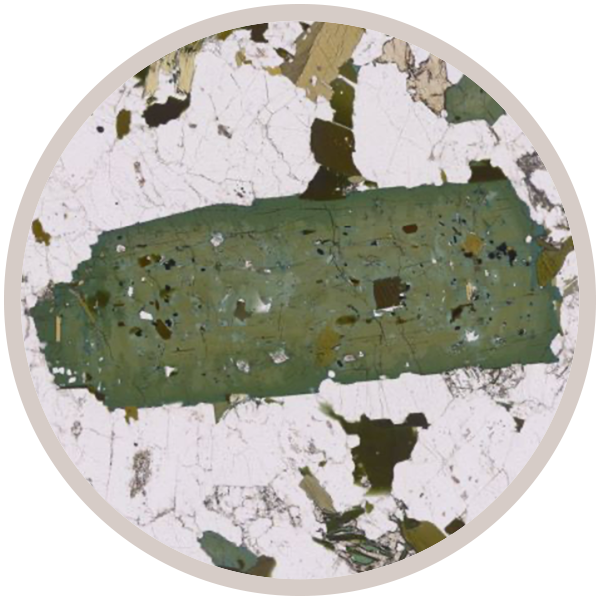
View 2 shows textures characteristic of deformation. Hornblende grains have undergone grain size reduction through dynamic recrystallization, while quartz shows extensive undulose and patchy extinction, with substantial subgrain development.
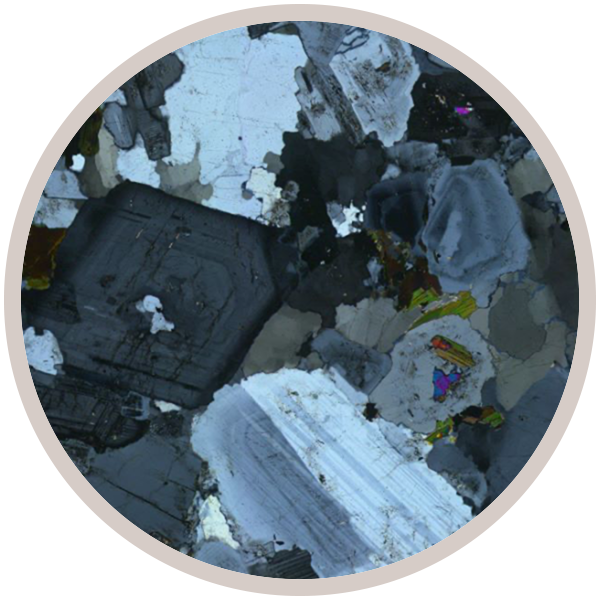
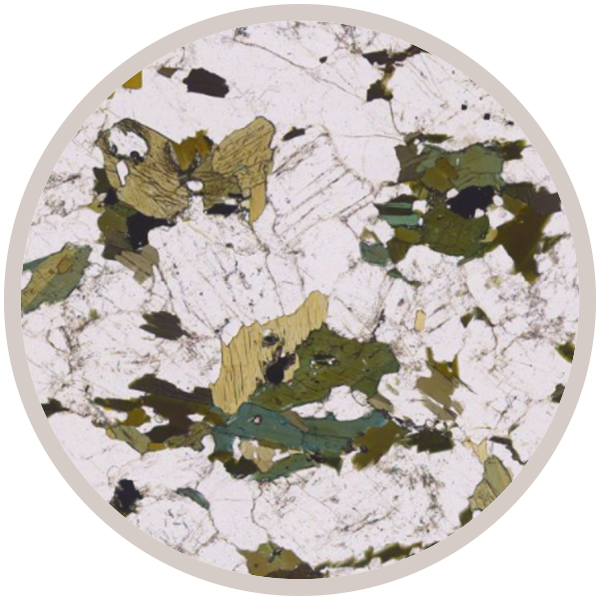
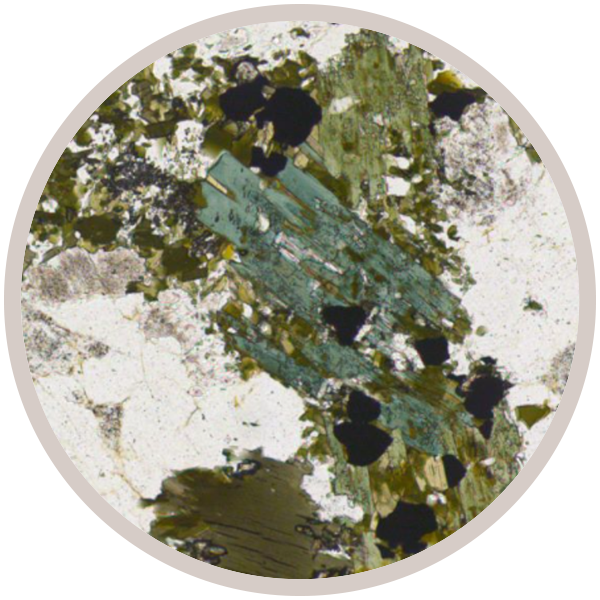
View 3 is a lower-strain domain, with well-formed hornblende and biotite crystals. Some recrystallization has resulted in finer grains decorating grain boundaries, of both hornblende and biotite. Hornblende shows good pleochroism in PPL, and one crystal is twinned. The large biotite grain has several small, high-relief crystals (titanite?) clustered round its margins, a texture that occurs elsewhere in the section and may be related to the alteration.
References
Bateman, P.C., 1965, Geologic map of the Blackcap Mountain quadrangle, Fresno county California: Geologic Quadrangle map 428, 1 sheet; 1:63,500.
Bateman, P.C., 1992, Plutonism in the central part of the Sierra Nevada Batholith, California: U. S. Geological Survey Professional Paper 1483, 182 pp.
Chen, J.H., and Moore, J.G., 1979, Late Jurassic Independence dike swarm in eastern California: Geology, v. 7, p. 129–133.
Dodge, F. C. W., Papike, J. J., and Mays, R. E., 1968, Hornblendes from granitic rocks of the central Sierra Nevada Batholith, California: Journal of Petrology, v. 9, no. 3, p. 378-410.
Dodge, F. C. W., Smith, V. C., and Mays, R. E., 1969, Biotites from granitic rocks of the central Sierra Nevada Batholith, California: Journal of Petrology, v. 10, no. 2, p. 250-271.
Moore, J.G., and Hopson, C.A., 1961, The Independence dike swarm in eastern California: American Journal of Science, v. 259, p. 241–259.
Piwinskii, A. J., 1968, Studies of batholithic feldspars; Sierra Nevada, California: Contributions to Mineralogy and Petrology, v. 17, no. 3, p. 204-223.