Fact sheet
Tonalite of Glacier Point
FD-13 is a petrographically stunning clinopyroxene, biotite, hornblende tonalite. The sample was collected at Washburn Point in Yosemite National Park by Franklin C.W. Dodge, likely in 1964 or 1965, when he was newly appointed to the U.S. Geological Survey. This sample was the first of the “FD” series to be studied. Along with a quartz diorite (CL-1) from the Academy Quarry in the Foothills of the Sierra, FD-13 was selected to study the feasibility of performing K-Ar geochronology in clinopyroxene-bearing plutonic rocks (Kistler and Dodge, 1966). This sample exemplifies the complex work of defining “lithodemes”—plutonic equivalents of stratigraphic “formations”—in the Sierra. The rock was originally classified as part of the Sentinel Granodiorite of Calkins (1930) in the 1966 K-Ar study (Kistler and Dodge, 1966). It was then re-classified as Granodiorite of Illilouette Creek in an analytic data report by Bateman et al. (1984). Subsequent mapping by Dallas Peck (2002) recognized a cryptic plutonic contact confirming that the Tonalite of Glacier Point is a distinct body from the Sentinel Granodiorite. A newly obtained U-Pb zircon geochronology age for FD-13 (Lackey, J.S., Pomona College, written comm.) yields a weighted mean age of 93.2±0.4 million years old, consistent with its position at the margins of the Tuolumne Intrusive Suite.
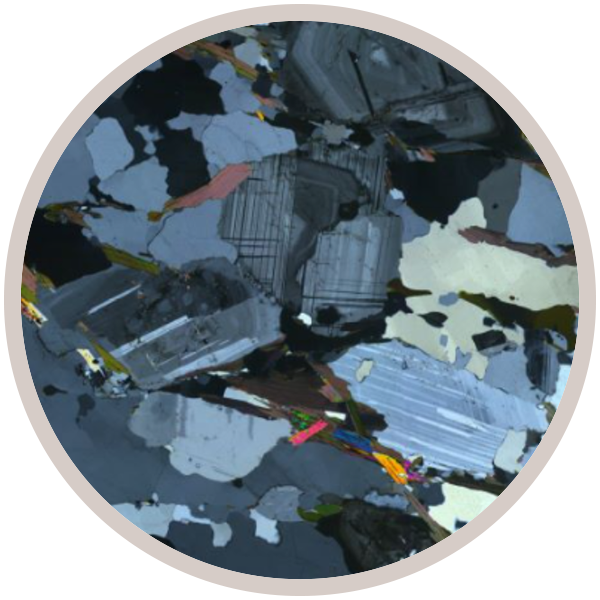
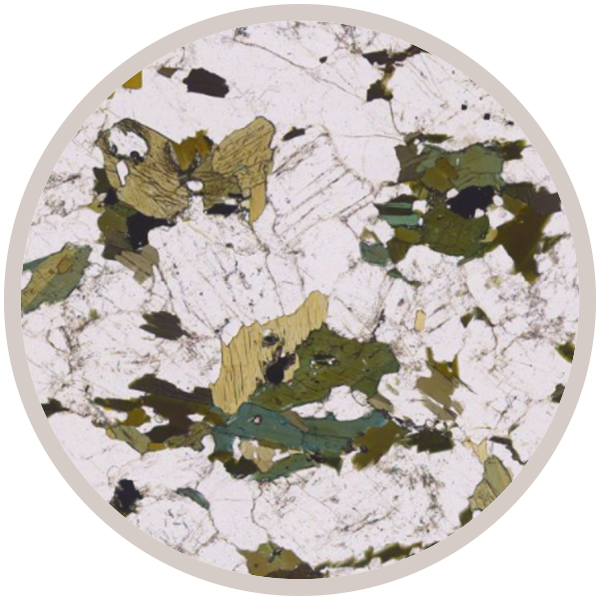
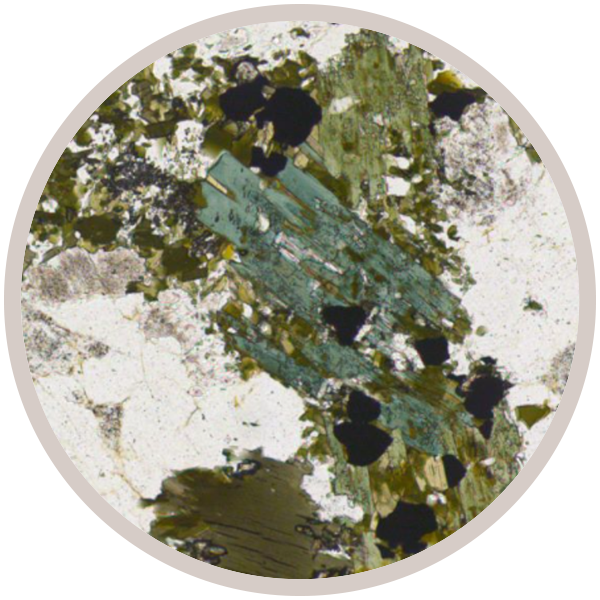
This is a lovely example of a granitoid with abundant mafic minerals. Pyroxenes, often with opaque oxides, occur as individual grains and clusters, commonly mantled by green hornblende. Both pyroxene and hornblende are in turn mantled by large biotite phenocrysts. Some plagioclase crystals feature cores rich in fine-grained inclusions of hornblende, pyroxene and biotite; in many cases, these inclusions appear crystallographically aligned within the feldspar crystal.
View 1 focuses on a biotite phenocryst with an inclusion of twinned clinopyroxene, as well as a couple of opaque oxides.
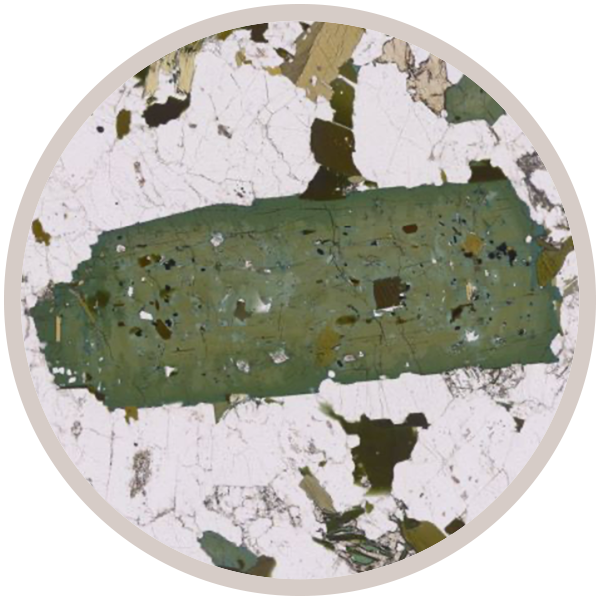
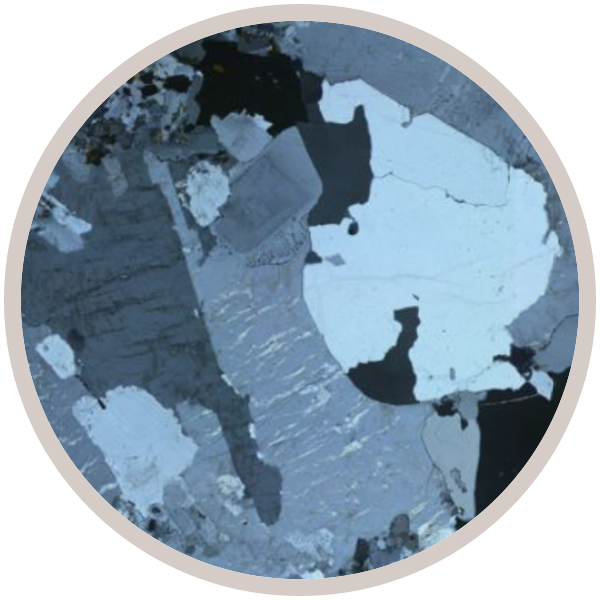
View 2 illustrates a common texture in this rock, where green hornblende overgrows much paler clinopyroxene. Although the three areas of pyroxene appear separate, they are in optical continuity, going into extinction at the same time; this suggests they are part of one crystal. The replacement, or overgrowth, of anhydrous pyroxene by hydrous amphibole implies an increase in the water activity of the crystallizing melt.
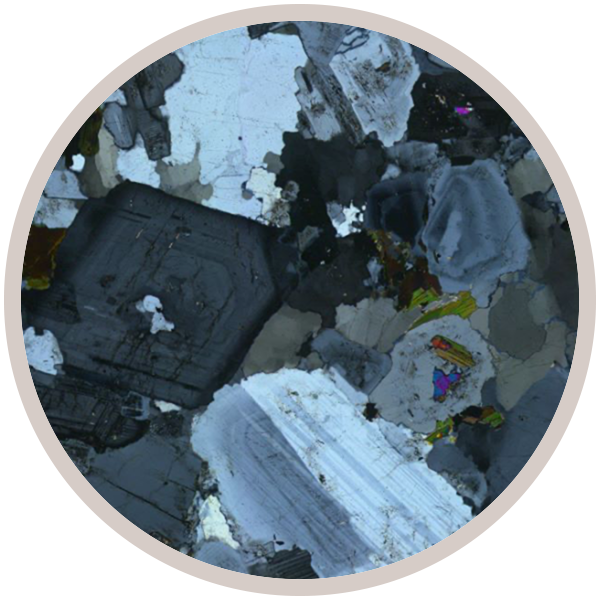
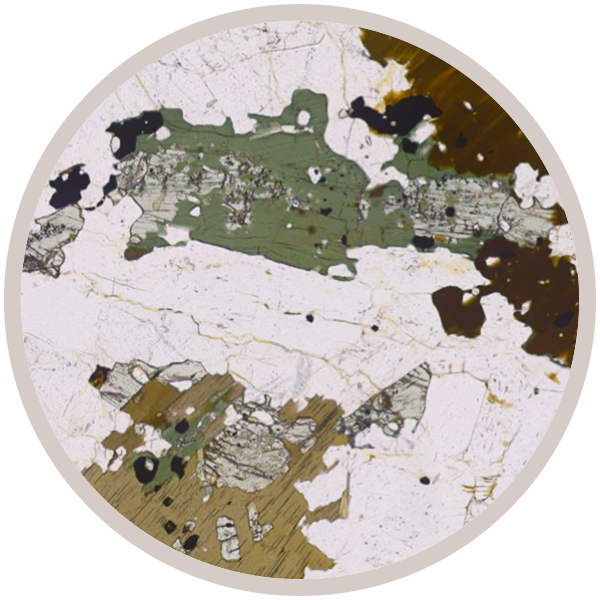
View 3 This large biotite grain includes hornblende that in turn mantles clinopyroxene, detailing the whole crystallization sequence. There are also single inclusions of hornblende, pyroxene and opaque oxides. To the lower left of the biotite is another example of hornblende mantling pyroxene. The isotropic area above the biotite is a hole in the section, with scattered dark blobs of carborundum, the abrasive used to lap and polish the thin section during its preparation.
References
Bateman, P. C., Dodge, F. C. W., and Bruggman, P. E., 1984, Major oxide analyses, CIPW norms, modes, and bulk specific gravities of plutonic rocks from the Mariposa 1 degrees by 2 degrees sheet, central Sierra Nevada, California. U. S. Geological Survey Open-File Report, v. 84-162, 59 pp.
Calkins, F.C., 1930, The granitic rocks of the Yosemite region. U.S. Geological Survey Professional Paper, v. 160, p. 120–129.
Kistler, R. W., and Dodge, F. C. W., 1966, Potassium-argon ages of coexisting minerals from pyroxene-bearing granitic rocks in the Sierra Nevada, California: Journal of Geophysical Research, v. 71, no. 8, p. 2157-2161.
Peck, D. L., 2002, Geologic map of the Yosemite Quadrangle, central Sierra Nevada, California. Geologic Investigations Series, Report: I-2751, 1 sheet, 1:62,500.