Fact sheet
El Capitan Granite is a coarse-grained biotite granite typical of the iconic El Capitan Granite of Calkins (1930). The “FD” prefix indicates El Capitan Granite sample was the 14th collected by Franklin C.W. Dodge under his initials as the sampling prefix; others like the Taft Granite (FD-12) and Half Dome Granodiorite (FD-15) were collected at the same time. The first instances of the FD-Sample series being analyzed is in the K-Ar study of mafic rocks by Kistler and Dodge (1966). This suggests that the samples were collected by Dodge near the end of his PhD research (Dodge, 1963) in Yosemite Valley, but not early enough to be used in any of the 1965 Geochronology studies. FD-14 was evidently collected from talus blocks at the base of cliffs approximately 1 km east of the namesake El Capitan monolith. Analyses of FD-14 were mostly restricted to major element data reported in compilations (Bateman et al. 1984).
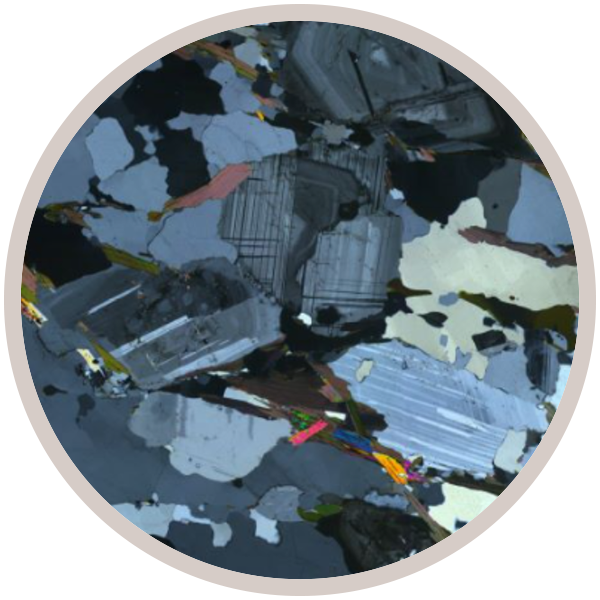
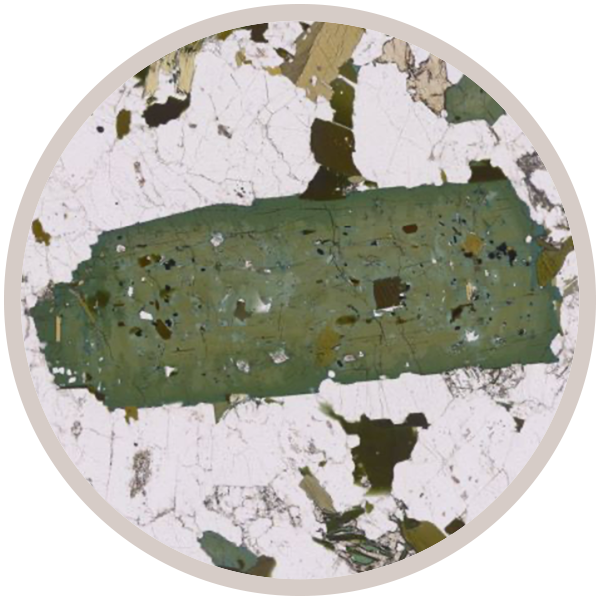
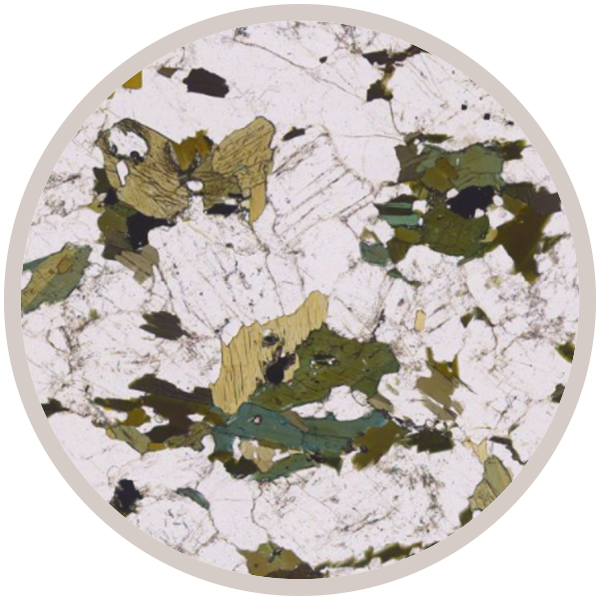
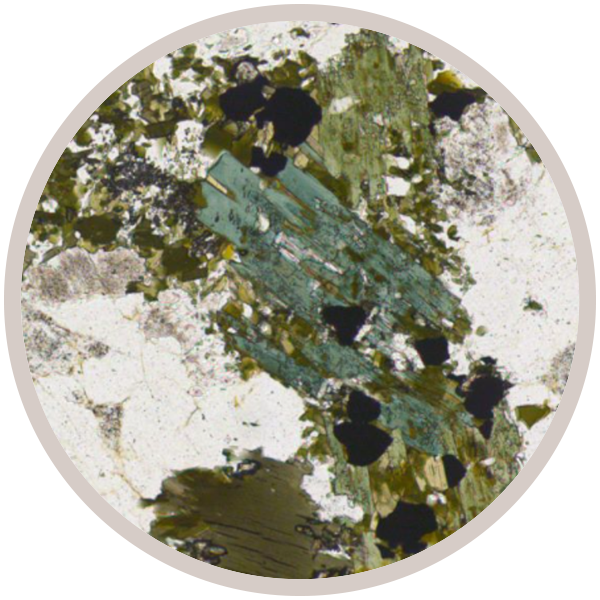
View 1 shows a notable texture which identifies this rock as igneous rather than metamorphic. Due to its phyllosilicate structure, biotite has a strongly preferred orientation. This causes phyllosilicate crystals to align when subjected to high pressure. View 1 shows that the biotite crystals do not have aligned cleavages, indicating that this rock has not been metamorphosed under a directed stress field. This random orientation confirms that this is an igneous rock.
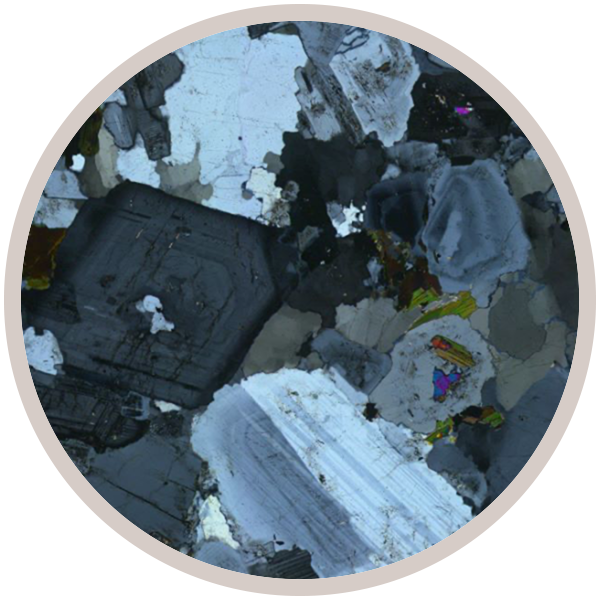
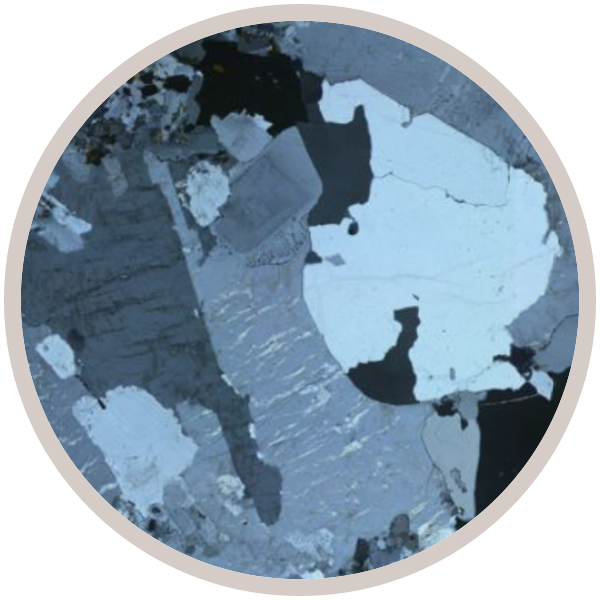
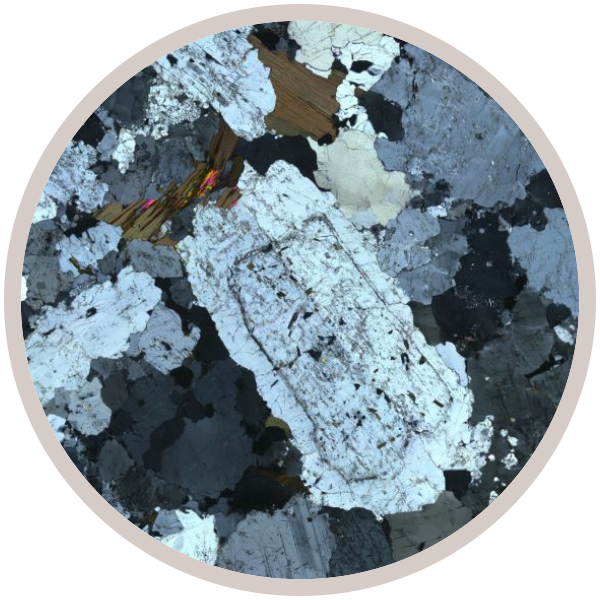
View 2 shows Carlsbad twinning in alkali feldspar (the tabular crystal occupying much of the lower left quadrant with the view set at 0°). This effect is caused by two crystal lattices growing with opposite lattice orientations, but still connected to each other. The crystal with Carlsbad twinning also shows overgrowth, where a second crystal growth event has directly continued the crystal lattice of a pre-existing crystal. This indicates two crystallisation events, most likely separated by a second melt injection. The overgrowth is separated from the core by a thin line of fine, dark inclusions that outline the tabular shape of the first-formed crystal.
This view also shows two secondary processes.
High birefringence specks (under cross-polarised light) in the feldspar crystals indicate the aqueous alteration of feldspar to fine-grained white mica, most likely sericite.
Additionally, the edge of one feldspar crystal in the top right quadrant also shows a texture like several dark tendrils within paler grey embayments reaching into the crystal. This texture is known as myrmekite, a feature whose origins have been much debated since its discovery in the late nineteenth century. The texture is thought to be triggered by deformation after igneous crystallization; the deformed feldspar lattices are then susceptible to alteration by K-, Na- or Ca-bearing hydrothermal fluids (alkali metasomatism). In this case, intergrowths of wormy quartz in plagioclase occur around the margins of K-feldspar crystals, which intuitively suggests replacement of a primary (igneous) K-feldspar crystal. However, some researchers believe that the lobes (or 'warts') of myrmekite are the final portions of incompletely-replaced, igneous plagioclase remaining after most of the crystal has been replaced by secondary K-feldspar. There are several other examples in this thin section, many of them with relationshops that are rather unclear or ambiguous.
Both of these processes are caused by reactions catalysed by the water sat within it. This water is derived from the way that the rock initially melted. Melting in subduction zones occurs in the presence of water, which dissolves in the melt and is transported upwards. When the melt cools and solidifies, the crystallisation of anhydrous phases like feldspar reduces the solubility of water in the melt, causing water to exsolve. This water sometimes escapes, but can remain along grain boundaries and react with the solid minerals. A similar alteration process can occur in biotite, which can be observed in Sierra Nevada samples MT-2 and SP-300.
For more information on crystal twinning, follow this link to the Manual of Minerals page on crystal features.
Go to Manual of Minerals - Features
For other examples of aqueous alteration processes, follow these links to Sierra Nevada samples MT-2 and SP-300.
References
- Calkins, F. C., 1930, The granitic rocks of the Yosemite region in Appendix of Matthes, F.E., Geologic history of the Yosemite Valley U.S. Geological Survey Professional Paper, v. 160, p. 120-129.
- Dodge, F. C. W., 1963, A mineralogical study of the intrusive rocks of the Yosemite Valley area, California. [PhD Dissertation]: Stanford University, 128 pp, 2 plates.
- Bateman, P. C., Dodge, F. C. W., and Bruggman, P. E., 1984, Major oxide analyses, CIPW norms, modes, and bulk specific gravities of plutonic rocks from the Mariposa 1 degrees by 2 degrees sheet, central Sierra Nevada, California: U. S. Geological Survey Open-File Report, v. 84-162, 59 pp.
- Kistler, R. W., and Dodge, F. C. W., 1966, Potassium-argon ages of coexisting minerals from pyroxene-bearing granitic rocks in the Sierra Nevada, California: Journal of Geophysical Research, v. 71, no. 8, p. 2157-2161.