Fact sheet
Lamarck Granodiorite, a medium grained, titanite-bearing hornblende-biotite granodiorite showing a wide range in plagioclase and hornblende size. This sample typifies the Lamarck’s darker look and greater overall abundance of mafic minerals than other granodiorites of the John Muir Intrusive suite along the Sierra Crest near Bishop, CA. The “MG” prefix designates it as one of the reference collection samples from the Mount Goddard 15’ Geologic Quadrangle. In formalizing names of plutonic units in the Bishop area, Bateman (1961) stated that “The Lamarck Granodiorite (Cretaceous) is here named after Mt. Lamarck. It is well exposed in the cirques east of Mt. Lamarck, which constitute the type locality.” Mount Lamarck is one of several peaks in the Evolution Group including Mounts Darwin, Wallace, Spencer, Fiske, Mendel, Haeckel, and Huxley. Data from MG-1 were first reported in 1965 by Kistler et al. and Hurley et al., and the sample would appear in dozens of additional inaugural studies in the next thirty years. A U-Pb zircon age of 92.1 ± 0.9 for MG-1 (Lackey, unpublished) is consistent with the range of ages previously reported for the Lamarck Granodiorite (e.g., Davis et al. 2012).
The main minerals that make up this sample are plagioclase feldspar, quartz, biotite and hornblende amphibole with minor amounts of alkali feldspar. This mixture of minerals means that the rock is a granodiorite, a coarse-grained igneous rock derived from melt of andesitic composition.
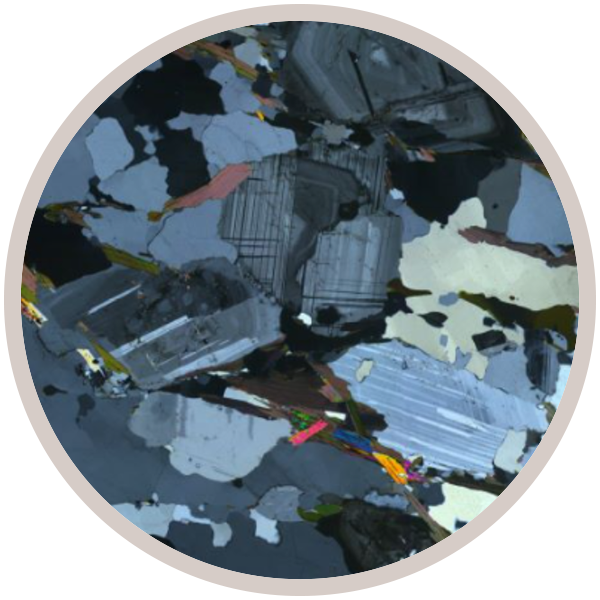
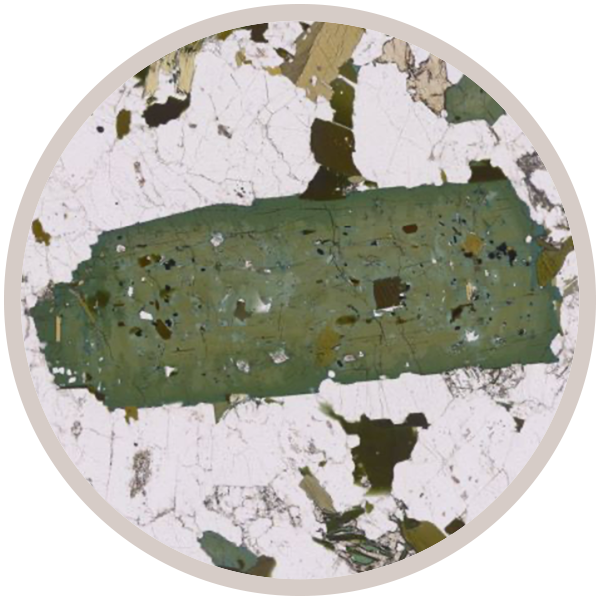
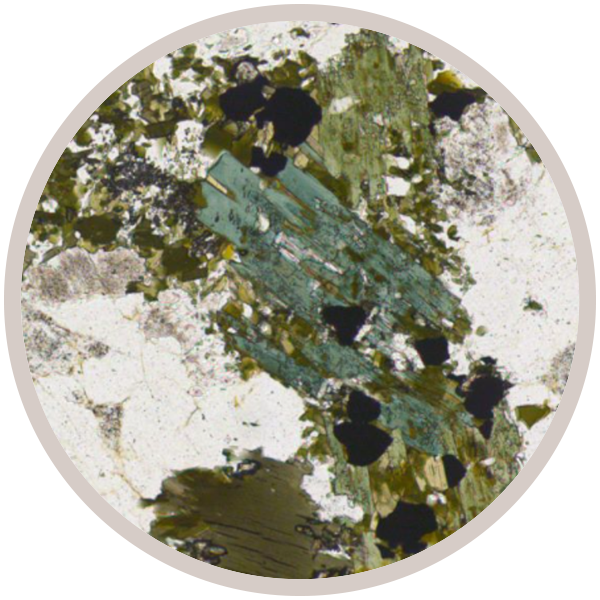
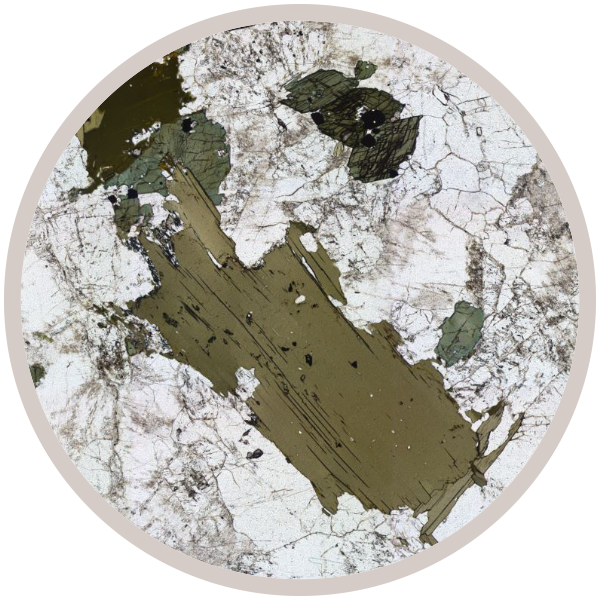
View 1 represents a good summary of the slide, with all of the major phases. Many plagioclase crystals are euhedral, indicating slow, steady crystallisation, implying slow cooling of the melt body. The amphiboles are excellent examples, with a very well defined lozenge habit and pair of cleavages intersecting at the 60°/120° angle which defines amphiboles. Some hornblende crystals also show simple twinning. Twinning is where two crystal lattices grow next to each other, in the same crystal, but with different lattice orientations. The biotite grains are also excellent specimens, with clear birdseye (mottled) texture in extinction (although this is not universal across all biotite crystals in thin section).
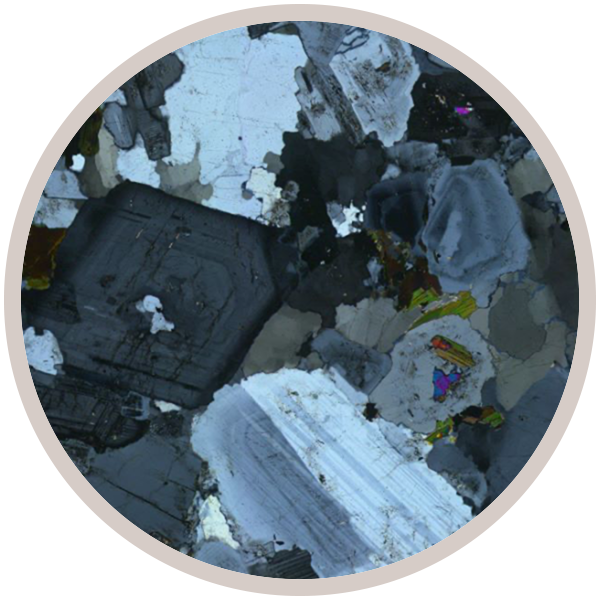
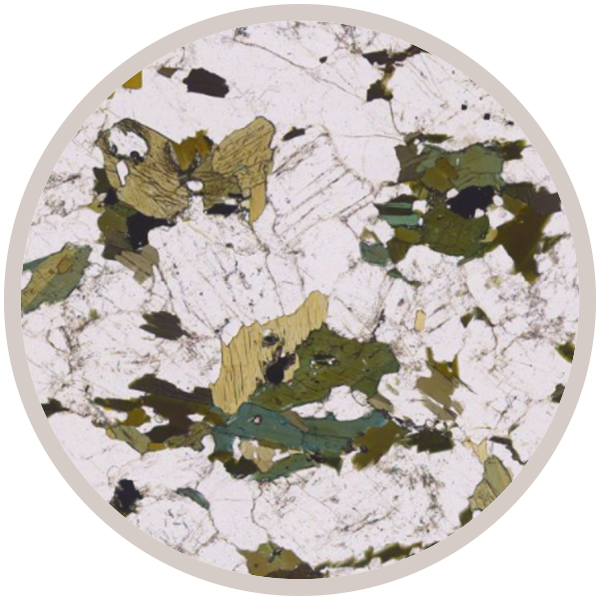
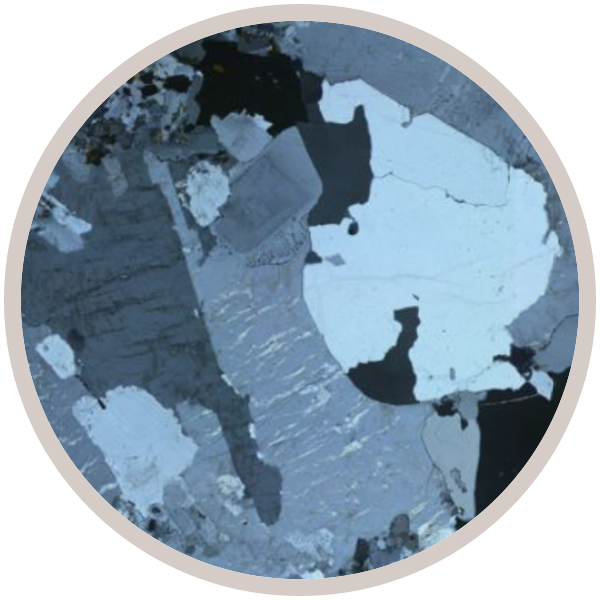
View 2 shows the interesting characteristics of the felsic components of the sample. One simple observation is the lamellar twinning that can be seen in the plagioclase feldspar. This works on the same principle as the simple twinning described above but with smaller scale alternations in lattice orientation. You can also see overgrowth of the plagioclase crystal. This occurs where a second crystallisation event directly continues the lattice of a pre-existing crystal, rather than seeding a new crystal. This likely indicates a second injection of melt into the system while the first batch of melt was still crystallising. This view also shows an important secondary process in plagioclase-rich rocks. Patches of bright colour in plagioclase crystals under cross-polarised light show where aqueous alteration reactions are converting the plagioclase into fine-grained white mica.
For more information about crystal twinning, follow the link below to the Manual of Minerals page on crystal features in thin section.
Go to Manual of Minerals - Features
References
- Bateman, P. C., 1961, Granitic formations in the east-central Sierra Nevada near Bishop, California: Geological Society of America Bulletin, v. 72, no. 10, p. 1521-1537.
- Kistler, R. W., Bateman, P. C., and Brannock, W. W., 1965, Isotopic ages of minerals from granitic rocks of the central Sierra Nevada and Inyo Mountains, California: Geological Society of America Bulletin, v. 76, no. 2, p. 155-164.
- Davis, J. W., Coleman, D. S., Gracely, J. T., Gaschnig, R., and Stearns, M., 2012, Magma accumulation rates and thermal histories of plutons of the Sierra Nevada batholith, CA: Contributions to Mineralogy and Petrology, v. 163, no. 3, p. 449-465.
- Hurley, P. M., Bateman, P. C., Fairbairn, H. W., and Pinson, W. H., Jr., 1965, Investigation of initial Sr87/Sr86 ratios in the Sierra Nevada plutonic province: Geological Society of America Bulletin, v. 76, no. 2, p. 165-174.