Fact sheet
Round Valley Peak Granodiorite, a conspicuously equigranular biotite hornblende granodiorite, was originally collected by Paul Bateman “1/4 mile northeast of Rock Creek Lake”. The type section of the Round Valley Peak Granodiorite is both sides of upper Rock Creek in the Mount Tom 15-minute quadrangle in Inyo County, California. In formalizing the name of this pluton, Bateman (1961) noted: “Since the name Rock Creek has long been pre-empted in formal stratigraphic nomenclature, the granodiorite is here named for Round Valley Peak, high point along Wheeler Crest, which is composed of granodiorite of typical appearance.” The first study reporting data on MT-2 was that of Larsen and others (1958): “Lead-Alpha ages of the Mesozoic Batholiths of Western North America”. There, MT-2 was called “PB-1,”presumably bearing Bateman’s initials, before Survey scientists decided upon the quadrangle naming convention (MT = “Mount Tom”). Larsen’s lead-alpha age of 88 million years old was remarkably close to the 89.1-million-year-old CA-ID-TIMS U-Pb zircon age reported for the Round Valley Peak Granodiorite by Davis and others (2012).
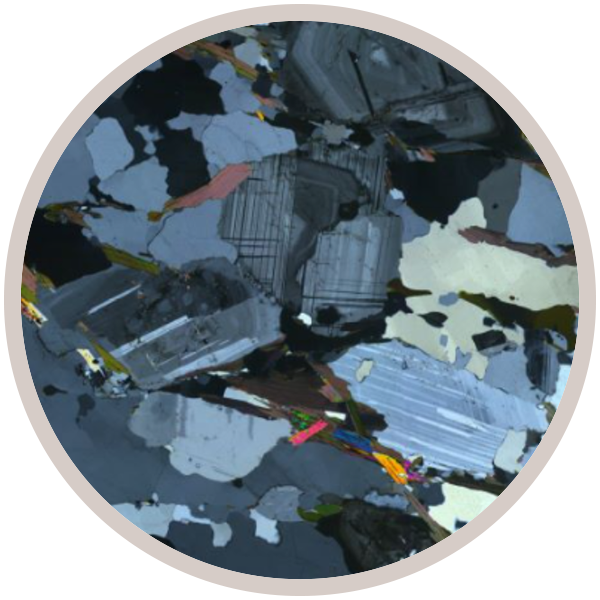
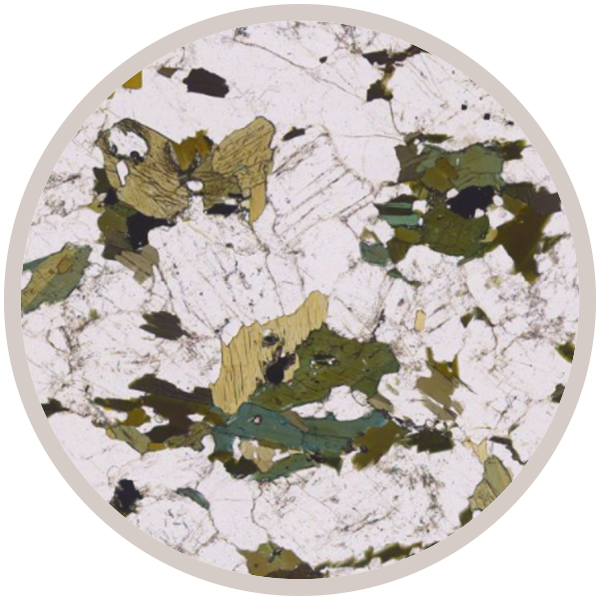
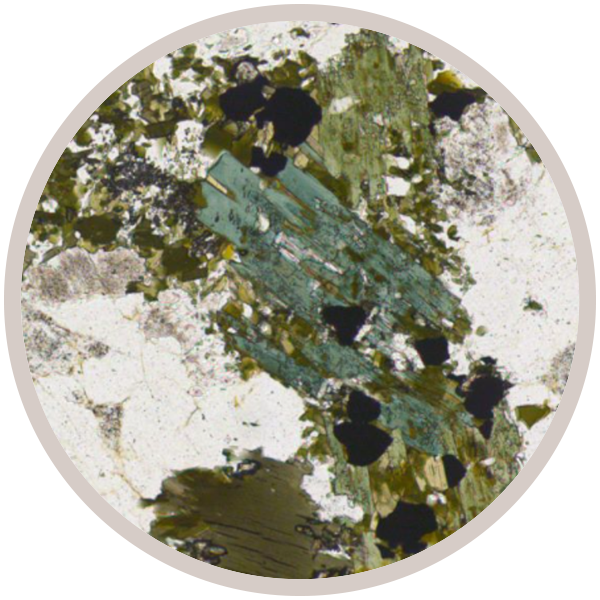
View 1 shows an interesting feature of this sample: the alteration of biotite to chlorite. This can be seen most clearly in view 1. The PPL view shows green discolouration of the brown biotite: this is the chlorite alteration. The zones of discolouration are elongate due to the preferential development of alteration along the cleavage planes of the phyllosilicate biotite. In some parts of the view this phenomenon can be observed in entirely regular, straight, bands through the biotite.
This process occurs due to reactions between the minerals and water in the rock. The water may be present due to the hydrous magma that crystallised to form these rocks. Melting originally occurred in the mantle wedge above a subduction zone in the presence of water, some of which dissolved in the ascending melt. When the melt solidified, the crystallisation of anhydrous minerals like plagioclase and lowered temperatures decreased the solubility of water in the remaining melt, causing water to exsolve in the rock. This water phase then, over time, reacted with the initial minerals, like biotite, causing alteration.
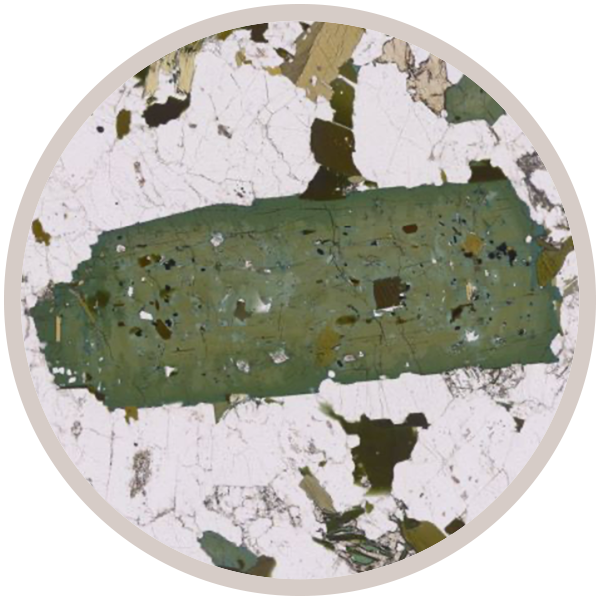
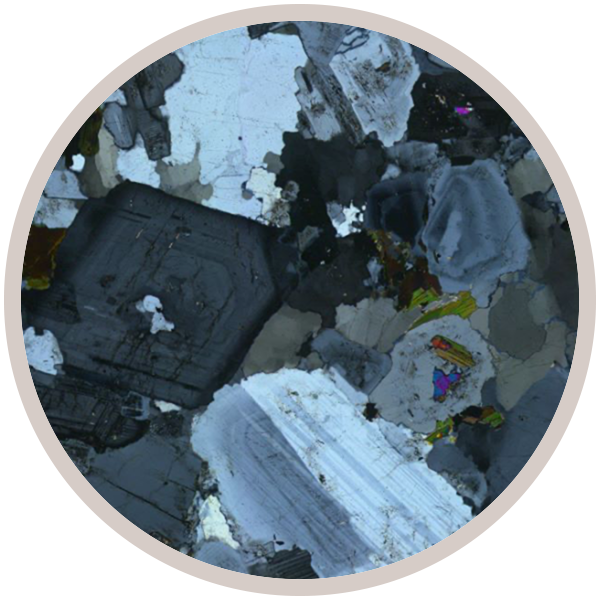
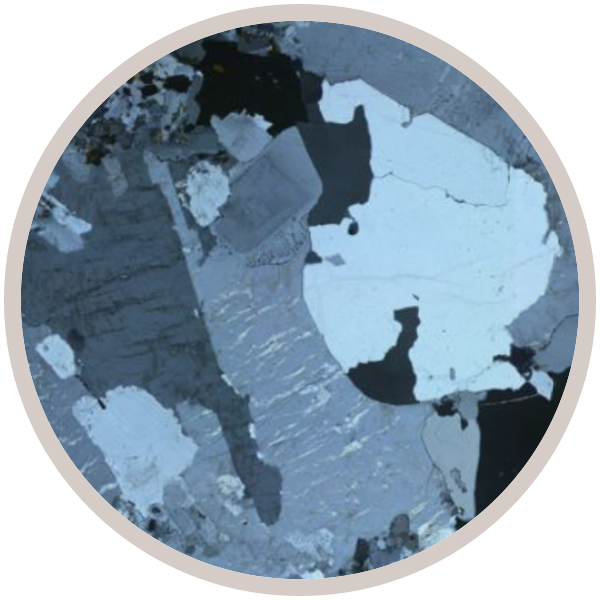
View 2 helps illustrate how this slide can also be used to generate a crystallisation history for the batholith.
The key observations are:
- Hornblende crystals are euhedral.
- Some hornblende crystals contain separate, smaller crystals of plagioclase, biotite and hornblende.
- Most biotites are anhedral but some contain other, euhedral, biotite crystals.
- Plagioclase is a mixture of euhedral and anhedral crystals, with anhedral being more common.
- Quartz is entirely anhedral and is intergrown with the anhedral biotite and plagioclase.
The key interpretations are;
- Two separate hornblende crystallisation events.
- Two separate biotite crystallisation events.
- Two separate plagioclase crystallisation events.
- The first events for each of these minerals were coeval
- One quartz crystallisation event
- Multiple crystallisation events implies a second injection of melt into the crystallising system
- The second event produces more mafic material (biotite), implying that the second batch of melt was more mafic than the first
- The high number of anhedral, intergrown, phases indicates that these phases crystallised together, implying rapid cooling.
- Cooling was, therefore, initially slower and sped up some time after the second melt injection
The timeline that can be derived is:
- 1st melt injection occurs
- Hornblende and biotite crystallise
- Plagioclase crystallises
- 2nd melt injection
- Large hornblendes crystallise
- More biotite and plagioclase crystallise, with quartz - rate of cooling increases.
References
Larsen, E. S., Jr., Gottfried, D., Jaffe, H. W., and Waring, C. L., 1958, Lead-alpha ages of the Mesozoic batholiths of western North America: U. S. Geological Survey Bulletin, p. 35-62.
Bateman, P. C., 1961, Granitic formations in the east-central Sierra Nevada near Bishop, California: Geological Society of America Bulletin, v. 72, no. 10, p. 1521-1537.
Davis, J. W., Coleman, D. S., Gracely, J. T., Gaschnig, R., and Stearns, M., 2012, Magma accumulation rates and thermal histories of plutons of the Sierra Nevada batholith, CA: Contributions to Mineralogy and Petrology, v. 163, no. 3, p. 449-465.