Fact sheet
Mount Givens Granodiorite: an equigranular biotite-hornblende granodiorite that is conspicuous in the greater size of biotite than hornblende which often exhibits euhedral grain forms. USGS Geologist N. King Huber collected SP-300 was during mapping of the Shuteye Peak (“SP” prefix) quadrangle between 1962–1966. Huber (1968) reports sample SP-300 is “from roadcut at Chiquito Creek, Sec. 20, T. 6 S., R. 24 E”. At this location, the Minarets Road traverses the northern “bulbous” protrusion of the Mount Givens pluton where it undergoes cycles of equigranular to porphyritic textural change and is older than areas domains to the south (see BCc-12). Frazer et al. (2014) obtained a CA-ID-TIMS U-Pb zircon age of 94.8–93.6 million years for a sample they collected at the Chiquito Creek roadcut. The sample was not widely used in Sierra Nevada reference set, and Bateman and Nokleberg (1978) opted to only use samples from their Kaiser Pass quadrangle mapping to frame their study “Solidification of the Mount Givens Granodiorite, Sierra Nevada, California”. Petrographic data, major element analyses, and normative analyses were reported by Huber (1968) quadrangle report and later in the Bateman et al. (1984) analytic data compilation.
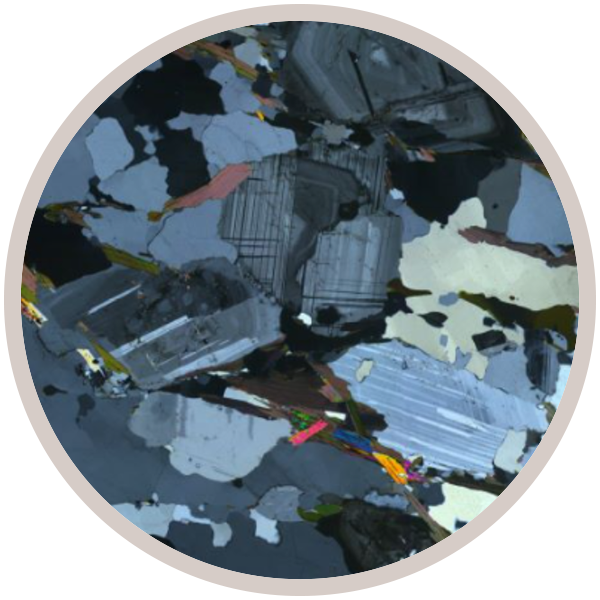
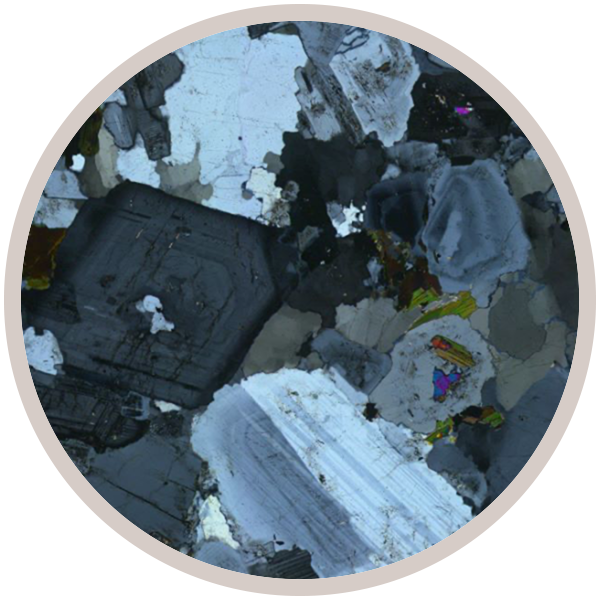
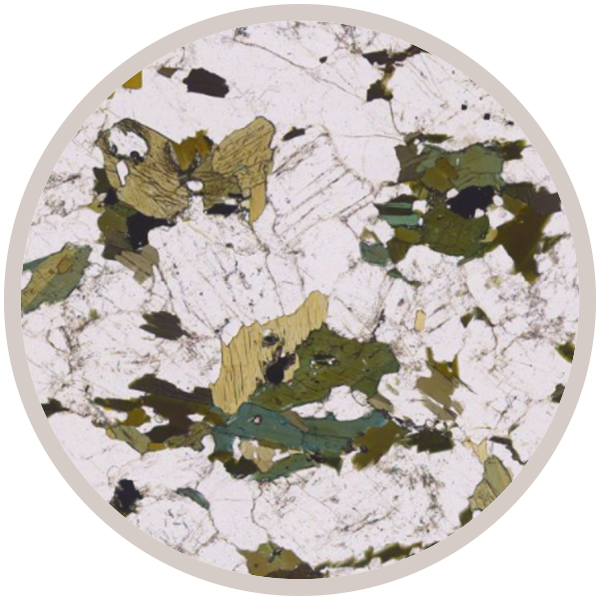
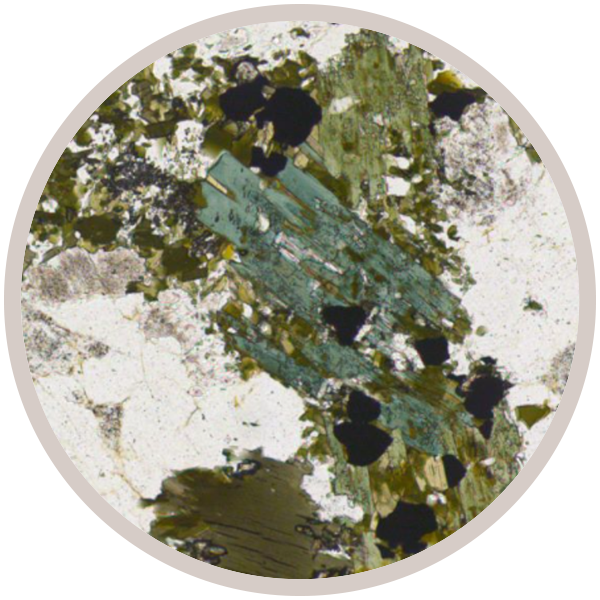
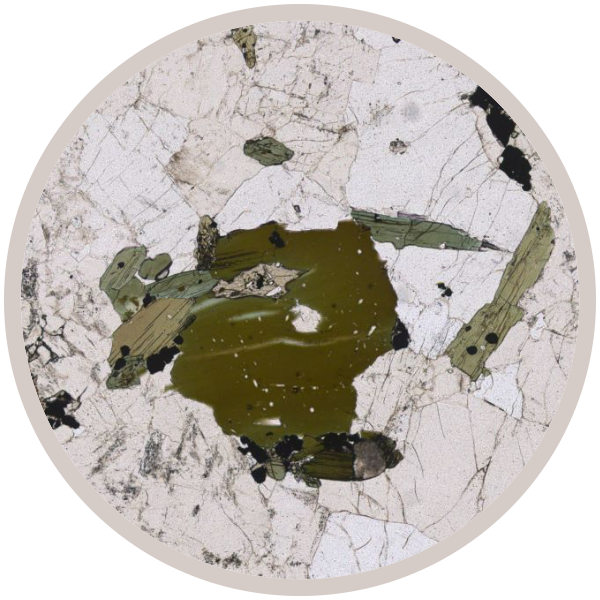
Based on the primary composition of plagioclase feldspar, quartz, biotite and hornblende, this rock is best classified as a granodiorite. It also has notable components of titanite (formerly known as sphene) and chlorite. The titanite crystallised from the melt but the chlorite derives from secondary aqueous alteration of the original biotite. The chlorite can be seen as patches of green discolouration in brown biotite crystals.
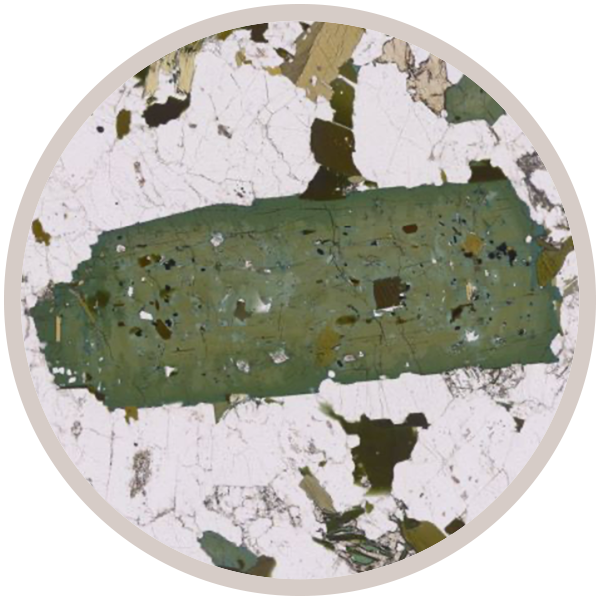
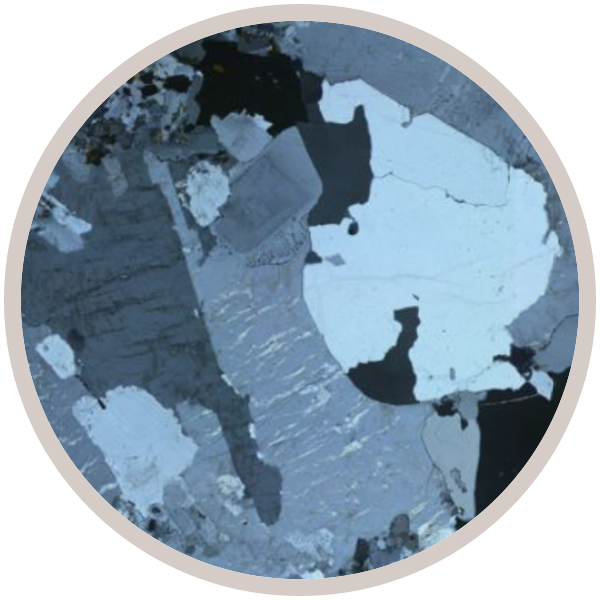
View 1 shows a good example of the mineral titanite, a calcium-titanium silicate, an accessory mineral which is very abundant in this unit. The view shows the primary identifying features of titanite. These are a lozenge habit and very high birefringence which creates a speckled, rainbow-hued effect under crossed polars. A similar degree of birefringence can be seen in calcite. Another identifying feature of this birefringence is that, halfway between extinction angles, the crystal colours in plain- and cross-polarised light appear to be the same.
View 2 shows oscillatory zoning in feldspar crystals. This indicates that the chemical composition of the crystallising plagioclase was changing over time, with separate 'bands' of the mineral having slightly different chemical compositions within the solid solution of plagioclase feldspar, showing up as different grey interference colours under crossed polars. The solid solution lies between the two end-members anorthite and albite:
Anorthite ---- Albite
CaAl2Si2O8 ---- NaAlSi3O8
For more information on chlorite replacement, follow this link to another sample from the Sierra Nevada, MT-2.
For more information on titanite and plagioclase feldspar, follow this link to the Manual of Minerals.
For more information on monotonic zoning, follow this link to the mineral features page in the Manual of Minerals
Go to Manual of Minerals - Features
Reference
- Huber, N.K., 1968. Geologic map of the Shuteye Peak quadrangle, Sierra Nevada, California. USGS Report 728.
- Bateman, P. C., and Nokleberg, W. J., 1978, Solidification of the Mount Givens Granodiorite, Sierra Nevada, California: Journal of Geology, v. 86, no. 5, p. 563-579.
- Bateman, P. C., Dodge, F. C. W., and Bruggman, P. E., 1984, Major oxide analyses, CIPW norms, modes, and bulk specific gravities of plutonic rocks from the Mariposa 1 degrees by 2 degrees sheet, central Sierra Nevada, California: U. S. Geological Survey Open-File Report, v. 84-162, 59 pp.
- Frazer, R. E., Coleman, D. S., and Mills, R. D., 2014, Zircon U-Pb geochronology of the Mount Givens Granodiorite: implications for the genesis of large volumes of eruptible magma: Journal of Geophysical Research: Solid Earth, v. 119, no. 4, p. 2907-2924.