Fact sheet
Cartridge Pass pluton interior phase
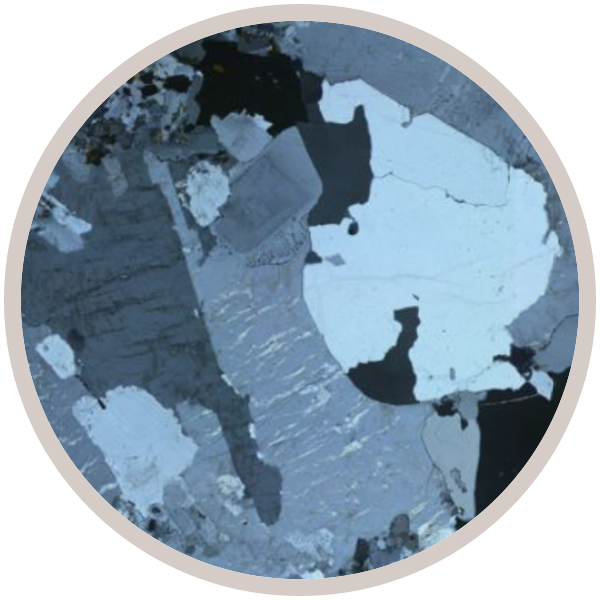
Biotite granodiorite of the interior of the Cartridge Pass pluton, eastern Sierra Nevada batholith. The sample was collected on the north side of Lake Basin by James G. Moore of the U.S. Geological Survey in 1956 or 1957 (Moore, J.G. written communication) during the final stages of mapping of the Mount Pinchot quadrangle west of Independence, California. Moore (1963) reported pronounced compositional zoning in the pluton: a darker, border zone with abundant mafic minerals transitioned to a low color index (< 5% mafic minerals) interior. This rock was one of five representative samples in the pluton selected by Dodge and Moore (1968) for detailed study. They analyzed whole rock geochemistry, mineral modes, and biotite compositions to assess magma redox chemistry across the pluton. A Cretaceous K-Ar age was reported for the pluton by Dodge and Moore (1968).
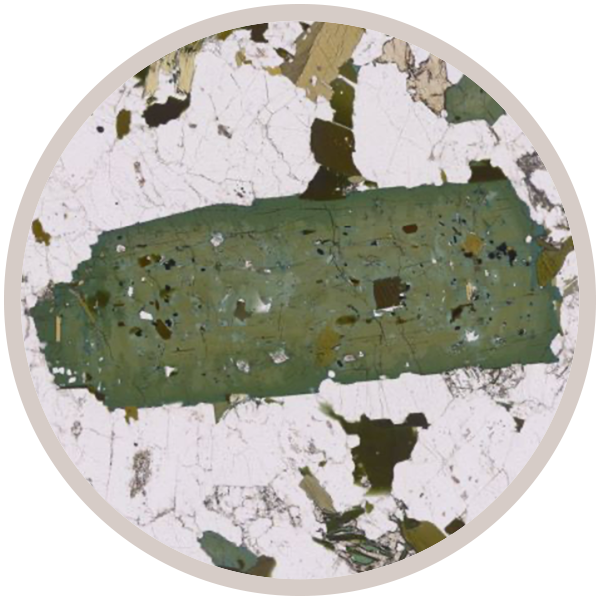
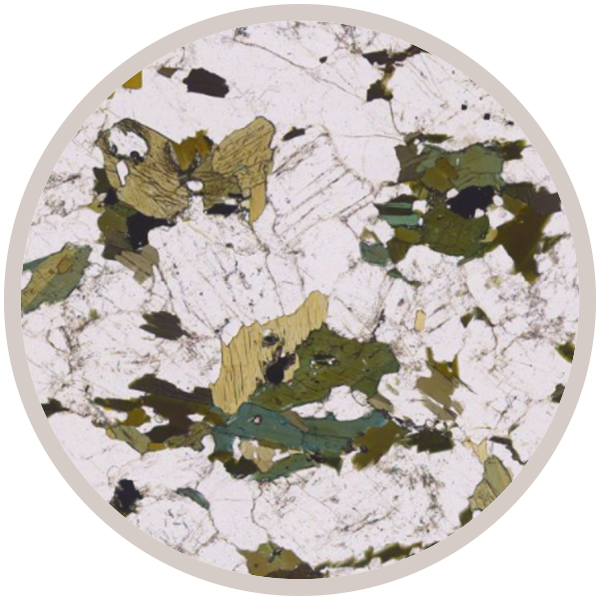
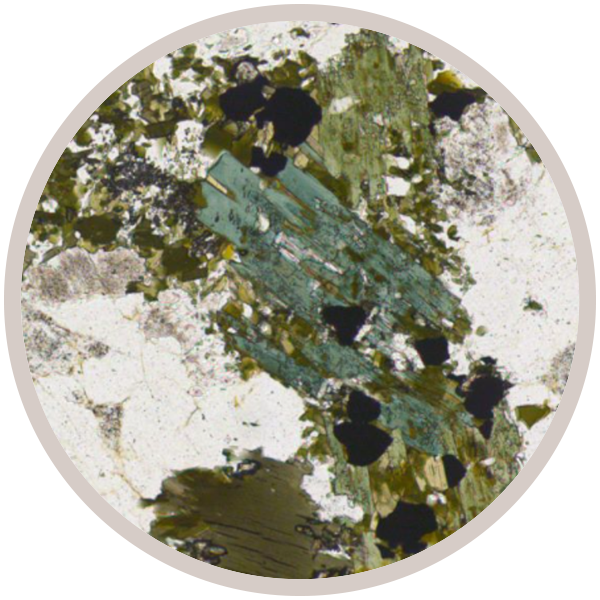
View 1 is a cluster of coloured and high relief minerals, including biotite, chlorite, opaque oxide, titanite and epidote. Euhedral titanite crystals show characteristically high interference colours, which are dominated by the absorption colour. The epidote nestled by the biotite displays typical anomalous blue and yellow interference colours.
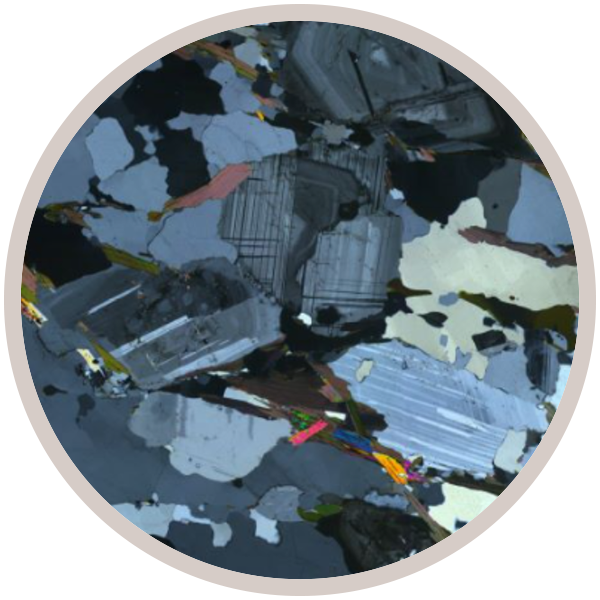
View 2 contains mainly colourless minerals - quartz, plagioclase and K-feldspar - which display striking textures under crossed polars. Plagioclase has lamellar twinning, while late, interstitial K-feldspar has unmixed during cooling to cross-hatched microcline. Symplectite textures are also evident. Some vermiform intergrowths with lobate forms appear myrmekitic, while other, more tabular examples may be granophyric.
View 3 shows several plagioclase crystals, which display considerable variation in size, shape, twinning and zoning. Two larger tabular crystals have oscillatory zoning, whereas some smaller grains are very strongly zoned from core to rim.
References
Dodge, F.C.W., and Moore, J.G., 1968, Occurrence and composition of biotites from the Cartridge Pass Pluton of the Sierra Nevada Batholith, California. U.S. Geological Survey Professional Paper 600-B, p. B6–B10.
Moore, J.G., 1963, Geology of the Mount Pinchot quadrangle, southern Sierra Nevada, California. U.S. Geological Survey Bulletin, v. 1130, 152 pp.
This collection features legacy samples from some of the earliest eras of geologic mapping of Sierra Nevada batholith, California, by United States Geological Survey mappers including Paul C. Bateman, James G. Moore, Donald C. Ross and Franklin C.W. Dodge.
These samples, among others assembled over 30 years, formed a reference collection of compositions, textures and ages of rock units across the batholith.
This Collection is the result of a partnership between the Virtual Microscope and a trio of researchers from the United States: Jade Star Lackey (Pomona College), Emily Cooperdock (Brown University), Jaime Barnes (University of Texas, Austin), who are supported in this endeavour by United States National Science Foundation Grants EAR-2211241, -42, and -43.