Fact sheet
FD-15 is a hornblende-biotite granodiorite from the world-famous Tuolumne Intrusive Suite in Yosemite National Park. Franklin C.W. Dodge collected this sample in the mid-1960s “from outcrop about 300 m W of Tioga Road near Dana Meadows” just inside the east entrance of Yosemite. Despite its early collection it did not appear in any of Dodge’s Sierra Nevada reference collection studies. In fact, the first data to be published from the sample appeared among miscellaneous entries in the “Tuolumne Meadows Quadrangle, California –Analytic Data” report of Bateman et al. (1988). FD-15 is listed after the fifty-two “Z” series samples that signify the legendary Sierran collaborations of Bruce Chappell (Australian National University) and USGS researchers Paul Bateman and Ron Kistler (Bateman and Chappell, 1979; Kistler et al., 1986). Those studies were the first in the Sierra to measure BOTH isotopes (O and Sr) and whole rock geochemistry, across a texturally and compositionally zoned intrusive suite. That work would influence thinking about the relationship of magma sources and emplacement/crystallization processes for decades.
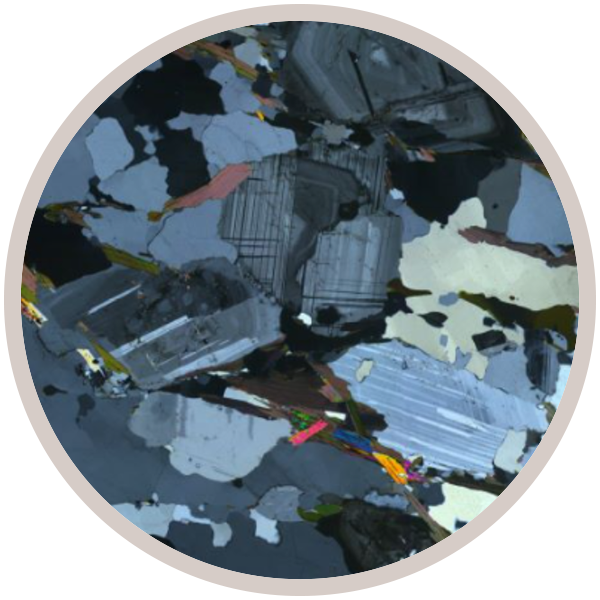
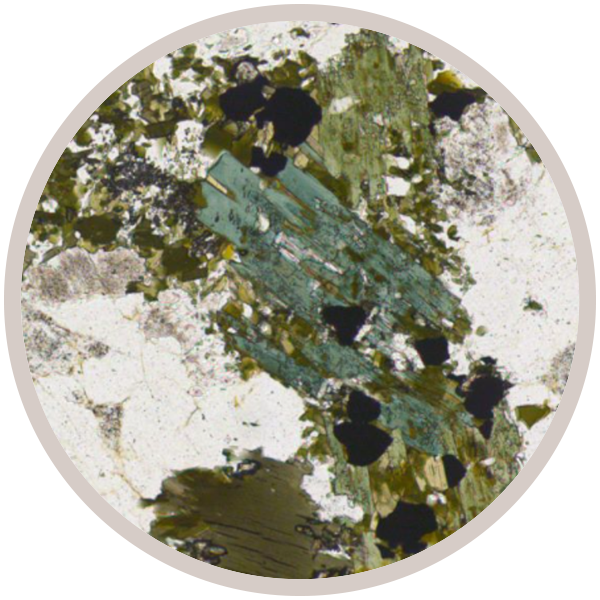
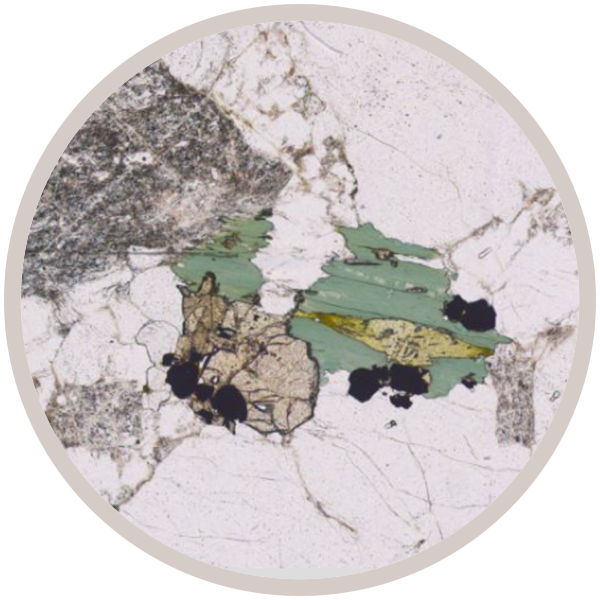
View 1 is graced by an elongate, yellowish epidote grain enclosed in pleochroic green chlorite, which shows anomalous brownish interference colours. Also present is a cluster of high relief titanite grains.
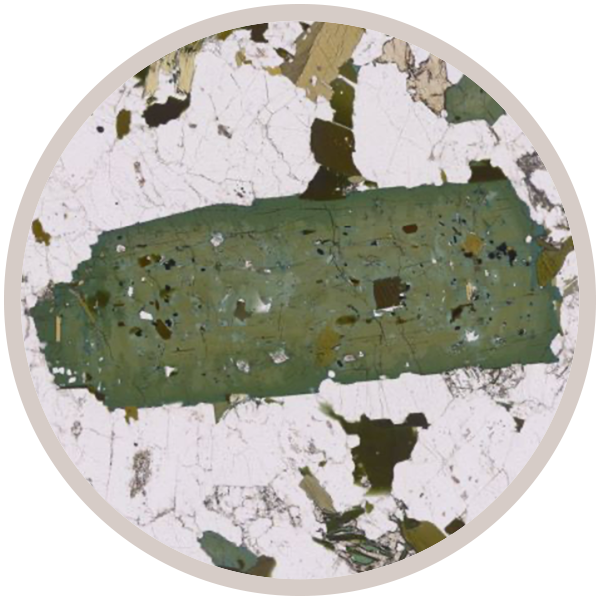
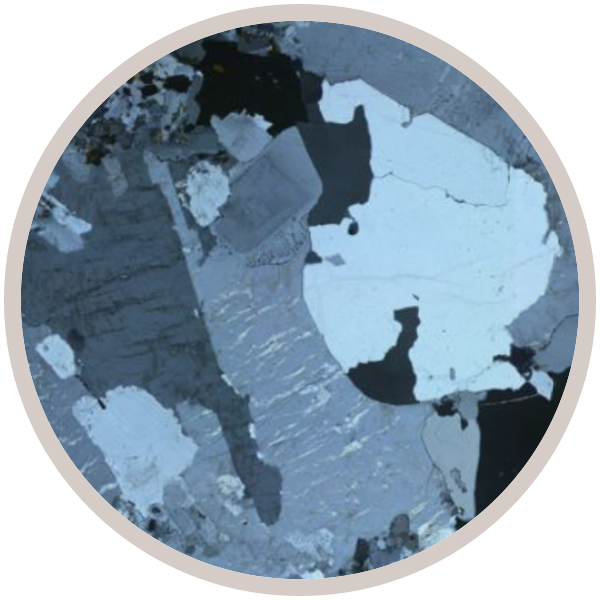
View 2 features a doubly-terminated, euhedral zircon crystal displaying typical third-order green interference colours, embedded in plagioclase and quartz crystals.
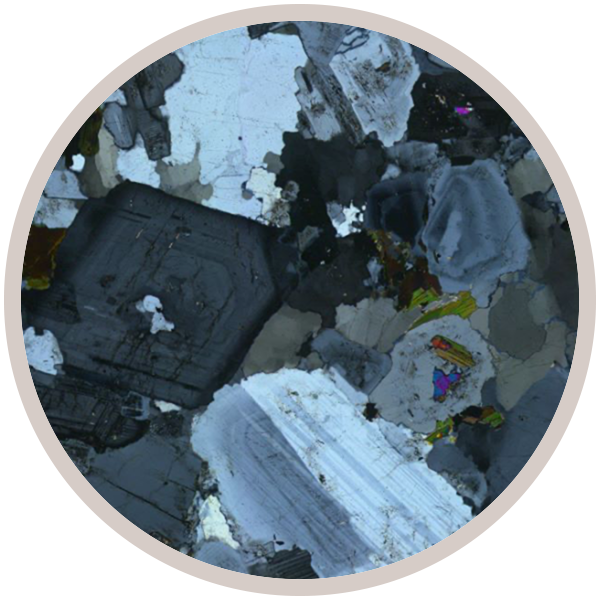
View 3 is dominated by a striking twinned hornblende crystal, strongly pleochroic, with extensive patchy colour zoning conspicuous in plane polarised light. Feldspars in the field of view are strongly sericitised.
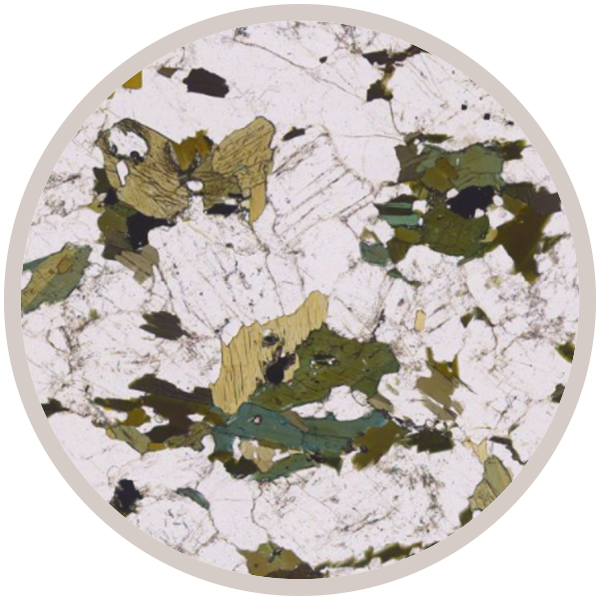
View 4 is a varied ensemble of minerals, including sericitised plagioclase and unaltered, clear quartz. Under the cross-hairs is epidote, with interference colours ranging from anomalous blue to yellow and pink. More epidote crystals are enclosed in a hornblende that again has patchy colour zoning.
References
Bateman, P.C., and Chappell, B.W., 1979, Crystallization, fractionation, and solidification of the Tuolumne Intrusive Series, Yosemite National Park, California. GSA Bulletin, v. 90, p. 465–482.
Bateman, P.C., Chappell, B.W., Kistler, R.W., Peck, D.L., and Busacca, A.J., 1988, Tuolumne Meadows Quadrangle, California; analytic data. U. S. Geological Survey Bulletin, v. 1819, p. 43.
Kistler, R.W., Chappell, B.W., Peck, D.L., and Bateman, P.C., 1986, Isotopic variation in the Tuolumne intrusive suite, central Sierra Nevada, California. Contributions to Mineralogy and Petrology, v. 94, p. 205-220.
This collection features legacy samples from some of the earliest eras of geologic mapping of Sierra Nevada batholith, California, by United States Geological Survey mappers including Paul C. Bateman, James G. Moore, Donald C. Ross and Franklin C.W. Dodge.
These samples, among others assembled over 30 years, formed a reference collection of compositions, textures and ages of rock units across the batholith.
This Collection is the result of a partnership between the Virtual Microscope and a trio of researchers from the United States: Jade Star Lackey (Pomona College), Emily Cooperdock (Brown University), Jaime Barnes (University of Texas, Austin), who are supported in this endeavour by United States National Science Foundation Grants EAR-2211241, -42, and -43.